
Lohengrin

| Martin Rajna | |||||
| Grand Choir “Hungarian State Opera Children’s Chorus, Chorus and Orchestra | ||||||
Date/Location
Recording Type
|

| Heinrich der Vogler | András Palerdi |
| Lohengrin | Szabolcs Brickner |
| Elsa von Brabant | Klára Kolonits |
| Friedrich von Telramund | Károly Szemerédy |
| Ortrud | Szilvia Rálik |
| Der Heerrufer des Königs | Kostas Smoriginas |
| Vier brabantische Edle | Botond Pál |
| Benjámin Beeri | |
| Zhaochi Xu | |
| Alex Vereshchak | |
| Stage director | András Almási-Tóth (2025) |
| Set designer | Sebastian Hannak |
| TV director | László G. Kecskés |
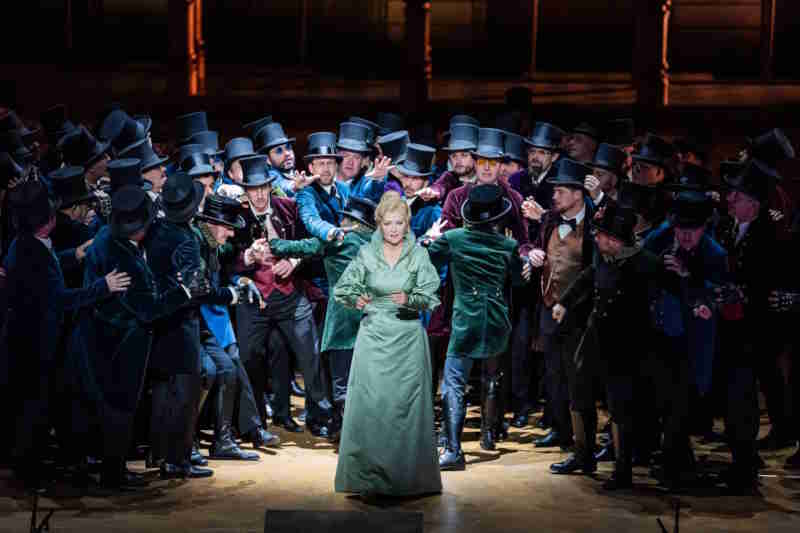
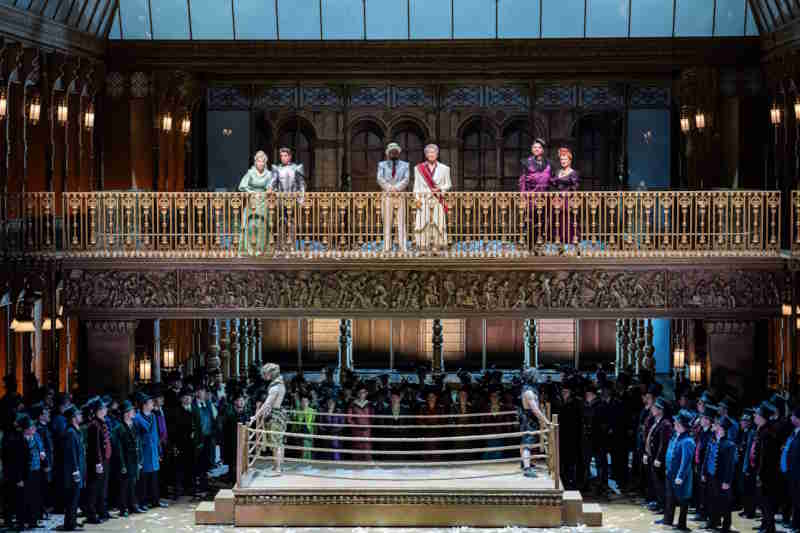
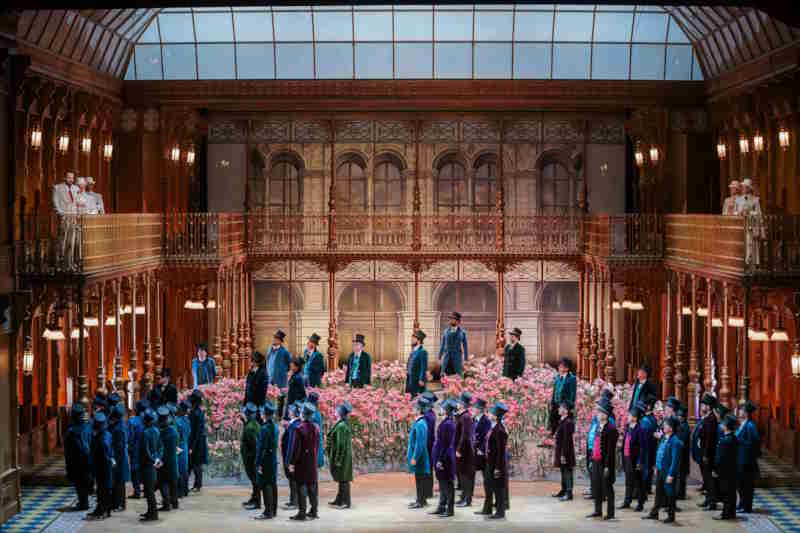

All that glitters is not gold in Budapest’s new Lohengrin
The Hungarian State Opera last staged Lohengrin in 2004, in a still-infamous production by Katharina Wagner which shifted the opera’s setting to the 1989 revolutions and turned Lohengrin into a populist leader, in a soberly pessimistic and greatly prescient evaluation of Central European regime changes.
In replacing Wagner’s socreal bureaus and grey-suited apparatchiks, András Almási-Tóth’s so-called “steampunk” Lohengrin seems anxious not to offend, sticking to straightforward storytelling and only moving the setting to the mid-19th century. Sebastian Hannak’s sets situate the opera in a gold-plated courtyard, though the (presumed) ducal palace’s tacky splendor could pass for a shopping arcade. The Telramunds’ and Elsa’s bedrooms, a striking combination of monochromatic black and gold, make an appearance in Acts 2 and 3 in a vertically split box. Krisztina Lisztopád’s generically Victorian costuming is somewhat garish for the principals, but well tailored and agreeably colorful for the chorus, with velvet frock coats and dresses (though the above-ankle dresses strike me as a century too early here).
Unfortunately, if Almási-Tóth’s concept was to expose a profound emptiness beneath this prosperous society’s glamour, his staging proves to be much the same: flashy, with little substance. Beyond cursory gestures communicating a sexist attitude, we learn little of this world’s ways, values or relevance. Lohengrin, who arrives bedecked in tinfoil armor, seems appropriately alien, yet he feels simply blank and grey as his garb, without much of a supernatural aura. An actually steampunk setting could have leant him a fantastical bent, but the staging isn’t even aesthetically interested in pursuing its supposed genre of choice. Instead, it opts for the superfluous inclusion of a black and golden pair of feuding swans: abducted and enchanted, Gottfried will appear as a mix of the two. The black swan’s alliance is self-explanatory, but the golden one is confounding: visually aligned with Elsa and a symbol of Brabantine society, it also stands for the outsider Lohengrin in the duel. The swans’ struggle, offering mostly unnecessary, distracting stage business, ultimately ends in Ortrud’s triumph: Gottfried returns restored but corrupted, capping the finale with a coup d’état.
Beyond this superficiality, a more frustrating aspect is the sheer technical clumsiness, both from Almási-Tóth and Hannak. The raised passageway in Act 1 that the king and most principals sing from is acoustically catastrophic and displays a characteristic problem with the stage space’s inconsistent treatment: the chorus, standing on the ground floor, turns away from the audience as the king addresses them, but turns back again when they have to sing – with their backs to the person they are meant to be replying to. This proves a recurring issue, as does the chorus’ direction in general: with awkward blocking, the stage is so cramped in the Act 2 finale that at “Zurück, Elsa”, Elsa and Ortrud are effectively immobile, rendering a dramatic high point a complete dud. In the finale, the female chorus sings from the parterre aisles because they simply have no space onstage, blocked out by the “bedroom” box. These are confounding misfires from seasoned professionals – and other than a few inspired moments of personenregie, the staging offers little in way of concept or execution to compensate for them.
Musically, the performance (the only one for the Hungarian cast) was somewhat dampened in vigor, as the house forces had to follow last evening’s premiere with an 11am matinee. Conductor Martin Rajna took a leisurely stroll through Act 1, conjuring more of a pleasant shimmer than ethereal beauty. The following acts were thankfully more tightly woven, energetic and dramatically impactful, with colorful playing from the orchestra, from the exquisite menace of the cellos in the Act 2 prelude to the lustily bombastic brass of the Wedding March, and reliable work from the chorus.
Debuting in the title role, Szabolcs Brickner got through the opera largely unscathed but achieved little more: his bright tenor’s tight sound doesn’t lend itself to lyricism, and his tone has a lachrymose quality that feels ill-suited to the Grail knight. (To his credit, his chemistry with Klára Kolonits’s Elsa was genuine and touching.) Kolonits, in a role debut of her own, was a radiant standout, her crystalline soprano lending impassioned purity and force of conviction to her Elsa, the most vividly portrayed figure of the staging. Szilvia Rálik’s penetrating tone and forceful gale of a voice made for an appropriately devious, dominant Ortrud, convincing in spite of a loose vibrato and tendency for cartoonish overacting. Sparks flew in her Act 2 duet with Károly Szemerédy’s dark, vehement Telramund, a clear musical highlight of the performance. András Palerdi’s dry-toned, gravelly Heinrich didn’t cut a vocally regal figure.
Orsolya Gyárfás | 16 November 2025
Zu dem Etikett einer kolportierten „festspielreifen“ Neuinszenierung passt am ehesten der Vergleich mit dem dritten Akt der „Meistersinger“, wo das Volk und Kinder auf der Festspielwiese ähnlich „herumwuseln“. Als ein „Märchen für Erwachsene“ aufgefasst entbehrt die Lesart von Regisseur András Almási-Tóth jeglicher Sinnlichkeit, abgesehen von zaghaften Umarmungen zwischen Elsa und dem Schwanenritter. Apropos Schwan: in dieser Produktion gibt es davon gleich drei. Einen „weißen“ für Elsa und Lohengrin und einen „schwarzen“ für Telramund und Ortrud, beide maskiert und mit bocksförmigen Hosen bekleidet. Diese beiden bestreiten auch stellvertretend für Lohengrin und Telramund den Kampf. Der dritte Schwan hält sich im Hintergrund, bis er zur Abreise von Lohengrin herbeigeholt wird und schließlich als Gottfried eine neue Ära verheißt. Als erlösende Hoffnungsgestalt darf dieser neue Herrscher von Brabant allerdings bereits während der Ouvertüre in Erscheinung treten. Der Regisseur ict also an einer chronologischen Erzählung der Geschichte nicht so sehr interessiert? Das Bühnenbild von Sebastian Hannak zeigt eine zur Bühne hin offene Halle, die britischen Kaufhäusern des 19. Jhd. mit ihren Metallkonstruktionen in Gold nachempfunden sein mag. Eine große Brücke im Vordergrund dient dem Auftritt der Protagonisten, eine Galerie jenem des Chores. Krisztina Lisztipád entwarf die eleganten Kostüme der Männer mit ihren britischen Top-Hats und die vor allem bunten Kostüme eines Teiles des Damenchores, während der andere Teil völlig in grün gewandet an eine illustre Jagdgesellschaft erinnerte. Den 2. und 3. Akt dominiert eine bühnenbreite Box mit einer schwarzen Seite für das Intrigantenpaar mit Video-Überwachungskameras und Flachbildschirmen. Zur Rechten das goldene Schlafzimmer für Elsa und Lohengrin. Wobei wir bei der Besetzung der Hauptpartien angelangt sind. Zusammengefasst kann man sagen, dass die rein ungarische Besetzung am Vormittag des 16.11., die auch vom ungarischen Fernsehen aufgezeichnet wurde, über weite Strecken besser war als die mit internationalen Gästen gespickte und im Vorfeld bereits gehypte Aufführung des Vorabends.
Dem 1991 geborenen US-amerikanischen Tenor Christopher Sokolowski wird vorausgesagt, der “neue“ Jonas Kaufmann zu sein. Doch da liegen noch Welten dazwischen. Mag er auch jung und in silberner Ritterrüstung attraktiv und charismatisch erscheinen, so überzeugte sein Heldentenor lediglich im Forte. In den Pianostellen hörte sich seine Stimme stark verquollen an. Kein Vergleich zu Szabolcs Brickner in der Titelpartie, der den Lohengrin höhensicher sowohl im forte als auch in den Pianostellen sang. Johanni van Oostrum fiel durch markige bisweilen auch schrille Spitzentöne auf, im Gegensatz zu Klára Kolonits mit angenehmem Timbre. Judit Kutasi war eine kraftvoll und mit schönem Mezzotimbre singende Ortrud, während Szilvia Ráliks eher heller Sopran eine gewisse Schärfe an manchen Stellen nicht verbergen konnte. Der lettische Bassbariton Egils Siliņš glänzte als Telramund mit seiner unverkennbaren kraftvollen Stimme und perfekten Diktion gegenüber dem ungarischen Bariton Károly Szemerédy, dem es für die erforderliche Verschlagenheit der Rolle etwas an bedrohlicher Tiefe der Stimme fehlte. Kostas Smoringinas sang den Heerrufer in beiden Aufführungen, der am Ende der Oper durch Ermordung von König Heinrich gemeinsam mit Gottfried einen Regierungswechsel herbeiführt. Der australische Bassbariton Derek Welton sang den König mit einem eher hellen Timbre, während sein ungarischer Kollege, der Bass András Pallerdi, seine Rolle mit majestätischer Tiefe ausfüllte. Die vier brabantischen Edlen wurden von Mitgliedern des Opernstudios kraftvoll interpretiert. Der junge Dirigent und Assistent von Ádám Fischer, Martin Rajna, leitete das Orchester der ungarischen Staatsoper mit großer Wagner-Kenntnis und gestaltete ein homogenes, spannendes Klangbild. Der von Gábor Csiki geleitete Chor der ungarischen Staatsoper sang auf bekannt höchstem Niveau, während der von Nikolett Hajzer einstudierte Kinderchor eigentlich entbehrlich war.
Zwei große Aufführungen knapp hintereinander endeten mit großen Beifallsbekundungen, denen sich der Rezensent nur bedingt anschließen konnte.
Harald Lacina | 17.11.2025
 (4/10)
 |
Hungarian subitles
The Hungarian TV recorded performances with the second cast.