
Siegfried

| Roberto Kalb | |||||
| Atlanta Opera Orchestra | ||||||
Date/Location
Recording Type
|

| Siegfried | Stefan Vinke |
| Mime | Rodell Aure Rosel |
| Wotan | Greer Grimsley |
| Alberich | Zachary Nelson | Fafner | Alexander Köpeczi |
| Erda | Lindsay Ammann |
| Brünnhilde | Lise Lindstrom |
| Waldvogel | Amber Norelai |
| Stage director | Tomer Zvulun (2025) |
| Set designer | Erhard Rom |
| TV director | Felipe Barral |


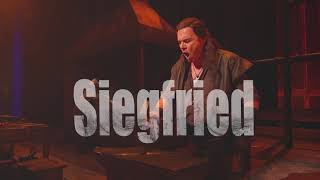
Atlanta Opera’s ‘Siegfried’ a stirring, heroic triumph
Few opera singers in the world can handle the enormous demands of Richard Wagner’s Siegfried, but Atlanta Opera has one of the best.
Heldentenor Stefan Vinke is triumphant in the title role of Wagner’s Siegfried, continuing through May 4 at the Cobb Energy Performing Arts Centre. At opening night on April 26, Vinke sounded as fresh and sturdy at the end of the opera as he did five hours earlier when it began.
Vinke is joined by a superb cast of Wagnerian singers that make this Atlanta Opera production a stirring addition to the first two installments of Wagner’s four-opera Der Ring des Nibelungen. Atlanta Opera mounted productions of Das Rheingold and Die Walküre, the first two operas in the cycle in 2023 and 2024, respectively
Next year, Götterdämmerung (The Twilight of the Gods) concludes Atlanta’s Ring, marking perhaps the most ambitious project in Atlanta Opera’s 46-year history.
Siegfried is a coming-of-age drama centered on the young hero of the title who forges a sword, slays the dragon Fafner and seeks to rescue the Valkyrie Brünnhilde. At the heart of the entire saga, of course, is a ring that will grant ultimate power to the person who possesses it, though more often it brings destruction.
Vinke wonderfully captures the hero’s wide-eyed innocence. It’s a remarkably youthful portrayal by a singer who is in his late 50s. Vinke may be the world’s reigning Siegfried, having performed the role more than 100 times. Siegfried requires tremendous vocal power, stamina and range, and Vinke possesses these qualities in abundance.
The opera itself is a mix of heroic epic, fairy tale (a singing dragon!) and occasional comedy. Vinke and stage director Tomer Zvulun embrace the inherent comic aspects of Siegfried, and it was a pleasure to hear the Atlanta audience enjoying moments of humor on opening night. (I can attest that at the Bayreuth Festival Theatre, the shrine of Wagner opera, audiences don’t laugh. More’s the pity.)
The production offers a projected translation in English, of course, but no translation was offered for Siegfried’s funniest line, “That is not a man!,” when he first encounters Brünnhilde.
Wotan, the king of the gods who is prominent in the first two Ring operas, returns in Siegfried but in the guise of a mysterious Wanderer. The bass Greer Grimsley, whose commanding Wotan was one of the highlights of the Atlanta Opera’s earlier Ring operas, was set to play the Wanderer, but he has been suffering from allergies and was unable to sing on opening night. And it’s not easy to find a Wotan on short notice to step in. Such are the challenges of live theater. But the Atlanta Opera forged a creative solution: On opening night, Grimsley acted and lip-synced the role on stage. Meanwhile, the Wanderer was actually sung by bass Kyle Albertson, who stood near the stage to the audience’s left. Kudos to the Atlanta Opera and Albertson, who brought a big, resonant and emotive bass to the role. What seemed like a potential disaster turned out to be a coup de théâtre. (As this review was being written, Atlanta Opera announced that Grimsley would be able to sing on the remaining performances.)
Siegfried can seem brooding at times. Its longueurs include extended patches of sung dialogue that recap earlier incidents in the Ring. It is a male-centered opera, too, and we don’t hear a female voice — and an offstage one at that — until deep into the second act. The voice belongs to the Forest Bird, sung in this production with a radiant soprano by Amber Norelai.
Siegfried doesn’t find Brünnhilde until late in Act III, more than four hours into the opera, and the two share a long duet. In this production, it’s well worth the wait. The electrifying Lise Lindstrom sings Brünnhilde with a laser-focused soprano, concluding the opera with a glorious high C, a note for the ages.
Among the others in the fine cast, Rodell Rosel is a nimble singing actor with a bright tenor as Mime, Siegfried’s scheming guardian. Alexander Köpeczi sings Fafner, formerly a giant but now a dragon, with a sonorous, stentorian bass.
Zachary Nelson brings a robust baritone to the role of the Nibelung Alberich. The opulent voiced Lindsay Ammann is Erda, the all-knowing Earth Mother.
For the uninitiated, Siegfried is a very long opera. The Atlanta Opera has wisely scheduled an early curtain for most performances. The opening night performance began at 6:30 p.m. and concluded at about 11:40 p.m., although that included a 50-minute intermission for dinner.
Those who thrill to the arias of Puccini or Verdi may find Siegfried mystifying. There seem to be few actual tunes. Still, the opera includes some of Wagner’s finest music, such as the aforementioned duet and Siegfried’s sword-forging scene in Act. I.
As in any Wagner opera, the composer’s leitmotifs weave a magic spell in the sizable orchestra. Conductor Roberto Kalb draws detailed and polished playing from the excellent Atlanta Opera Orchestra. Kalb maintains a generally brisk momentum and a careful balance between singers and orchestra.
Tomer Zvulun, the director, once again brings a dynamic vigor to an opera that can become static.
Jason Hines’ puppets are marvelous, striking a balance between horror and fairy tale.
The production itself is visually arresting, thanks to Erhard Rom’s set and projection design, aided by Robert Wierzel’s lighting and Mattie Ullrich’s costumes. Rom’s dark, industrial design for Mime’s forge contrasts strikingly with the bright bucolic set of Act II as the hero Siegfried journeys from darkness to light and youth displaces the old order.
The Atlanta Opera seems to have been inspired by the Bayreuth Festival to offer an extended intermission for the audience to get a bite to eat. It’s a splendid idea. During intermission at the Cobb Energy Centre’s outdoor cafe, I enjoyed a couple of moderately-priced tacos that were really quite wonderful. Plus, with an opera like Siegfried, one needs time during the acts to recharge.
That’s because the old admonition to “sit back, relax and enjoy the show” doesn’t work with Wagner. One must sit forward, maintain keen alertness … and enjoy the show. Wagner demands much from an audience, but the rewards are bountiful.
Paul Hyde | April 30, 2025
The Atlanta Opera’s ‘Siegfried’ rises to the challenge of heroic performance
When the curtain rose Saturday night on Siegfried at Cobb Energy Performing Arts Centre, the gods themselves seemed to conspire against The Atlanta Opera. Greer Grimsley, the towering bass-baritone slated to embody the Wanderer—Wotan in his final, fateful guise—was sidelined by allergies due to Atlanta’s merciless spring pollen. In an extraordinary pivot, Kyle Albertson was flown in at the eleventh hour to sing the role from behind a scrim, cloaked in black, while Grimsley silently walked the stage, embodying Wotan’s doomed gravitas in pantomime. Though rare, such a dual performance is not unprecedented in opera when the stakes are high and the character’s presence indispensable. Grimsley hopes to recover in time to sing the second of four performances on Tuesday, but what could have spelled disaster on opening night instead became yet another testament to the company’s history of resilience—and set the tone for a Siegfried that pulsed with urgency, invention, and raw emotional force.
As the third and most transformative installment of Richard Wagner’s Der Ring des Nibelungen, Siegfried stands apart from its darker siblings in spirit and style. It is a hero’s journey that lifts the cycle from the claustrophobic gloom of Die Walküre into a realm of discovery, humor, and dangerous innocence—but it does not escape the shadow of inevitable doom. Here, the old world crumbles as the new hero forges his path, unknowingly sealing the gods’ fate. To navigate Siegfried successfully demands not only monumental vocal endurance but an acute grasp of the psychological tensions brewing beneath its brighter surface. The Atlanta Opera achieved a production that honored both the exuberant and the ominous currents of Wagner’s epic.
One could almost imagine Siegfried as a kind of “Concerto for Tenor and Opera Company,” and Stefan Vinke, one of today’s leading heldentenors, delivered a titanic performance in the title role. His voice, shining and inexhaustible, retained remarkable flexibility throughout the opera’s punishing demands, from the boyish curiosity of Act I to the triumphant awakening of Brünnhilde in Act III. Vinke’s Siegfried was no mere muscle-bound simpleton; he conveyed a hero of impulsive wonder, often dangerously unaware of the consequences of his power. Opposite him, Rodell Rosel offered a masterclass in character singing as Mime. Rosel’s bright, cutting tenor and meticulous diction captured Mime’s venomous cunning without tipping too far into caricature, grounding the dwarf’s deception in all-too-human desperation.
Despite his inability to sing live, Greer Grimsley’s portrayal of the Wanderer radiated authority through his physical presence, and Kyle Albertson’s noble, world-weary vocalization from behind the scrim was admirably secure and commanding given the last-minute circumstances. Together, they forged a surprisingly seamless portrayal of Wotan’s twilight struggle: the once-mighty god reduced to a seemingly powerless observer, orchestrating his own obsolescence.
Zachary Nelson brought a brooding Alberich to life, a sharp counterpoint to the decaying grandeur of Wotan. As Fafner, Alexander Köpeczi summoned a cavernous, menacing bass, enhanced by Jason Hines’ imaginative, atypical dragon puppet design, which cleverly balanced mythic terror with visual immediacy. Soprano Amber Norelai lent her light, silvery voice to the Forest Bird, projecting clarity and a touch of mischief. Mezzo-soprano Lindsay Ammann delivered a weary and sorrowful Erda in her brief but pivotal scene.
The moment of Brünnhilde’s awakening remains the emotional and dramatic fulcrum of Siegfried, and soprano Lise Lindstrom did not disappoint. Best known for her fearsome portrayals of Wagner and Strauss heroines, Lindstrom summoned a radiant, deeply human Brünnhilde. Her voice, ranging in tone from steely to tender, gloriously unfurled as she charted Brünnhilde’s tumultuous journey from divine being to mortal woman, culminating in an ecstatic union that nonetheless foreshadows the end of gods and heroes alike to come in Götterdämmerung.
The production, directed by Tomer Zvulun, embraced a cinematic, symbolically charged aesthetic. Scenic and projection designer Erhard Rom crafted a mutable visual world enhanced by Robert Wierzel’s dramatic lighting and Mattie Ullrich’s costumes.
The Atlanta Opera Orchestra, under Kalb’s steady and probing leadership, delivered Wagner’s vast, sinewy score with emotional depth and sweep. Kalb maintained a taut dramatic arc; even the opera’s more expansive passages never sagged into indulgence.
Ultimately, this Siegfried was a triumph born not just of talent, but of adaptability, perseverance, and a profound commitment to Wagner’s monumental vision. In facing down adversity both within the story and upon the stage, The Atlanta Opera offered its audience a rare kind of operatic experience: one that mirrored the myth it set out to tell, where heroism is not the absence of struggle, but its brave and brilliant embrace.
Mark Gresham | 28 APR 2025

 (7/10)
 |
English subtitles
This recording is part of a complete Ring cycle.