
Die Walküre

| Hans Knappertsbusch | |||||
| Orchester der Bayreuther Festspiele | ||||||
Date/Location
Recording Type
|

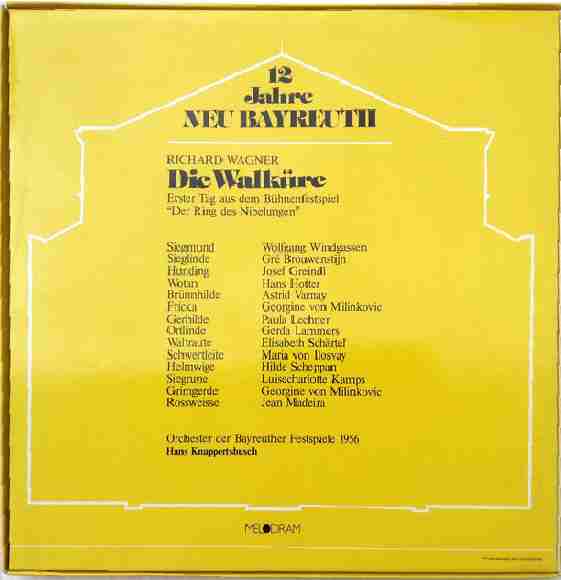
| Siegmund | Wolfgang Windgassen |
| Hunding | Josef Greindl |
| Wotan | Hans Hotter |
| Sieglinde | Gré Brouwenstijn |
| Brünnhilde | Astrid Varnay |
| Fricka | Georgine von Milinković |
| Helmwige | Hilde Scheppan |
| Gerhilde | Paula Lenchner |
| Ortlinde | Gerda Lammers |
| Waltraute | Elisabeth Schärtel |
| Siegrune | Luisecharlotte Kamps |
| Grimgerde | Georgine von Milinković |
| Schwertleite | Maria von Ilosvay |
| Roßweiße | Jean Madeira |

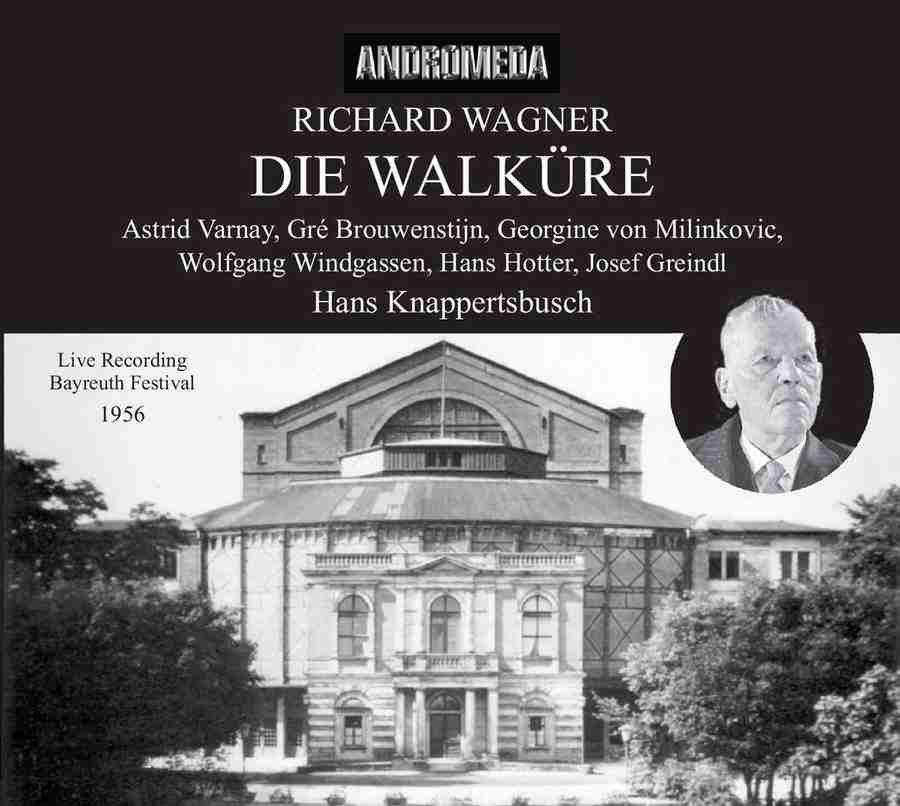
Having warmly welcomed Pristine’s remastering of Knappertsbusch’s Das Rheingold, I was keen to hear the next installment of his 1956 Ring at Bayreuth, performed the following evening.
Once again, the immediacy of the sound in the opening storm and pursuit music is astonishing – as good as any late 50s studio, stereo recording, some annoyingly persistent and inconsiderate coughing apart.
The cast is again as good as it gets; Windgassen was now far more experienced in the role of Siegmund, hence his performance is less accident-prone than it was when he debuted in the role for Clemens Krauss three years earlier – the only problem being that he was clearly unhappy with Kna’s more measured pulse and sometimes pushes ahead of the beat; as a result, he is too often out of synch, but despite some passing intonation issues, he is in as robust voice as I have ever heard him, darker and richer than was sometimes the case – admirable in his cries of “Wälse!”. He is matched by the fresh, vibrant Gré Brouwenstijn and Kna caresses the soaring lines of the love music so beguilingly. Greindl’s Hunding is black, faithful and steady – a really imposing, menacing presence. Knappertsbusch lets the tension slacken rather too much in Siegmund’s first narrative but the firmness, clarity and expressivity of Windgassen’s use of text give real pleasure. The first Act is still in many ways as compelling as any I know, my occasional slight reservations regarding the conductor’s measured beat and the rhythmic slips from Windgassen notwithstanding.
The Prelude to Act II is weighty and mighty, serving as a suitably heroic introduction to the two titanic voices we next hear: Hotter and Varnay. Both are in best voice; there is little of the rockiness which later set into the former’s bass-baritone, nor of the sliding to which the latter sometimes resorted; she sings with laser accuracy and power. Georgine von Milinkovic completes a trio close to ideal, just as the three principal singers in the first act were. The dramatic potential of key exchanges such as “Heut’ hast du’s erlebt!”, “Nimm den Eid!”, Wotan’s despair as he yearns for “das Ende!” and the Todesverkündigung between Brünnhilde and Siegmund is given maximum scope by artists who know how to “sing on the words”. A superb gaggle of Valkyries completes a cast of which today we can only dream. Only that constant, pitiless coughing from the audience – in mid-August? – it must have been all that smoking – spoils the idyll. Someone even manages to hack just before Wotan’s last “Geh!” as he contemptuously slays Hunding with a wave of his hand – and that is preceded by what sounds like an alarm clock going off; such are the vagaries of live performance.
The famous Walkürenritt is actually rhythmically tricky to pull off and it goes very well here under Kna’s steady hand, even if at first the brass occasionally marginally lag behind the beat. The whole act tingles with theatrical energy – Brouwenstijn soars in “O hehrstes Wunder!”, Varnay is wonderful in the tricky, chromatic “War es so schmählich” supplication, Hotter is profoundly moving in “Leb wohl”, its pathos enhanced by majestic conducting and playing; the agony of “einer…freier als ich, der Gott” (one freer than I, the God”), the tenderness of “Der Augen leuchtendes Paar” (that bright pair of eyes ) and “so küßt er die Gottheit von dir” (thus he kisses away your godhead) are palpable – not that it is enough to distract the tubercular terrorists. The whole is capped by a shimmering Magic Fire Music and Hotter’s magnificently hefty “Wer meines Speere Spitze fürchtet/durchschreite das Feuer nie!” (Whosoever fears the point of my spear/will never pass through the fire), silence, then rapturous applause and thunderous feet-stamping – fully deserved.
Were it not for the heedless coughing and Windgassen’s coordination problems, I would rate this Die Walküre as highly as any.
Ralph Moore | APRIL 18, 2024
This second instalment of the reissue of the 1956 Bayreuth Ring from Knappertsbusch, generally known as Kna, maintains the high standards of the first, along with the same weakness. This is that, although the microphones catch the voices well, the balance of the orchestra is not quite right. In the fully scored passages the brass need to cut through the texture with their motifs and too often they don’t stand out well enough. You can hear this in the preludes to the first two acts, where Solti’s studio performance is much better. This is a consequence of the layout of the sunken orchestra pit at Bayreuth together with hanging the microphones rather high. However, in the Walkürenritt this is not a problem. This could be that by then the engineers have adjusted the microphone or simply because in this passage Wagner unleashes the full power of his brass section. The woodwind are also sometimes too faint in the first two acts, but not in the third, which suggests that it is the microphone placement that has improved.
In the first act we meet Windgassen’s Siegmund and Brouwenstijn’s Sieglinde. Windgassen, well known for his Siegfried, which he also sings in this production, was a last minute substitute for Siegmund, as Ramón Vinay, who regularly sang the role at Bayreuth, was taken ill. Apart from the fact that it is confusing casting to have the same singer take the parts of both father and son, the characters of Siegmund and of Siegfried are quite different: Siegfried is cheerful, extrovert and unreflective; Siegmund is the opposite. Also, the role of Siegmund lies rather lower in the voice than Siegfried, and it suits Windgassen less well. (He told Solti and Culshaw that while he had always wanted to record Siegfried he did not feel the same about Siegmund.) Still, he does a grand job in the first act, both in the climaxes of the cries of Wälse and the pulling of Nothung from the tree, and also in the gentler Winterstürme quasi-aria. He does have a tendency to run in front of the beat and there are moments in the first act when he and Kna seem far apart but this is not too disconcerting.
Brouwenstijn, who was Freia in Rheingold, begins rather tremulously as Sieglinde, but that is probably her conception of the character rather than her singing but she grows in confidence after she returns to the stage, having drugged Hunding. The duet with Siegmund is compelling. Greindl is a baleful and menacing presence as Hunding, far tougher than in his previous appearance as Fasolt in Rheingold; indeed, he is almost too powerful: I would not be too confident about Siegmund’s encounter with this Hunding, even without the help of Wotan.
In the second act we meet again Hotter’s magnificently authoritative Wotan, and he really makes me feel that, at least from one point of view, the Ring is the tragedy of Wotan. He is in excellent voice throughout the work. His initial plan to build a safe place for the gods and to uphold the rule of law get subverted by his lust for power and the failure of his successive schemes. His Brünnhilde is Astrid Varnay, whose reputation I have long known but whom I never actually heard before. She, together with Martha Mödl, were the leading exponents of the role between Kirsten Flagstad and Birgit Nilsson. Varnay has a powerful, shining soprano with a slight tendency to scream. She scoops the upward leap in her Hojotohos, which takes some getting used to. On the other hand she is immensely impressive in the Todesverkündung scene with Siegmund and brings off her change of heart about protecting him without too much of a jolt. Georgine von Milinkovic is even more formidable as Fricka than she was in Rheingold, in her one scene in which she argues Wotan into submission. Brouwenstijn continues her affecting Sieglinde, particularly strong in her memory of the raid which destroyed her family.
In the third act we meet the Valkyrie band, whose singers happens to include two of the Rhinemaidens and Erda from Rheingold and also Fricka from the previous act, economical casting which I don’t think would be achievable today. They make a feisty band and Brünnhilde comes over more as first among equals than immediately outclassing them all. Sieglinde’s final appearance, ending with the redemption through love theme on its one and only appearance before the end of Götterdämmerung, is most moving. The dialogue between Wotan and Brünnhilde is tense and absorbing and Wotan’s farewell shows Hotter at his finest. In this third act, in particular, he is in better voice than in the Solti version, which was recorded last in his Ring cycle, ten years after this live performance. (Those not happy with Hotter in Solti’s Walküre should consider Leinsdorf’s 1961 studio performance, not part of a cycle, which has Brouwenstijn and Vickers as the Wälsungs, London as Wotan and Nilsson as Brünnhilde.)
Kna has been criticized for slow tempi, and he is sometimes slow, but not excessively so and he always keeps the music moving. He goes for slow-burn climaxes rather than the violent ones favoured by Solti, but both approaches are equally valid. The sound, originally in mono but here in Pristine’s Ambient Stereo, is full and rich. As with Rheingold this comes with access on line to downloadable orchestral and vocal scores and a German libretto. This a valuable reissue.
Stephen Barber | August 29, 2024
 (8/10)
 | Melodram |
 | GM, M&A, Orfeo, Andromeda, Pristine |
A production by Wieland Wagner (1951)
Wolfgang Windgassen replaces Ramón Vinay as Siegmund.
This recording is part of a complete Ring cycle.