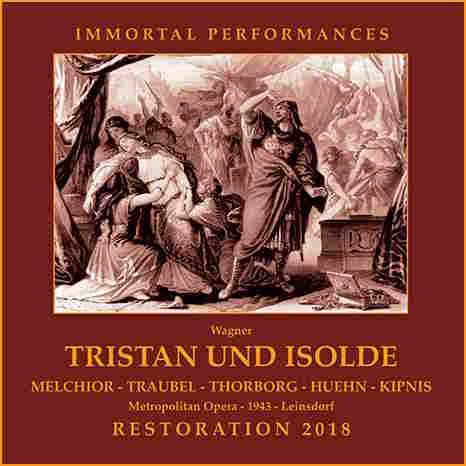
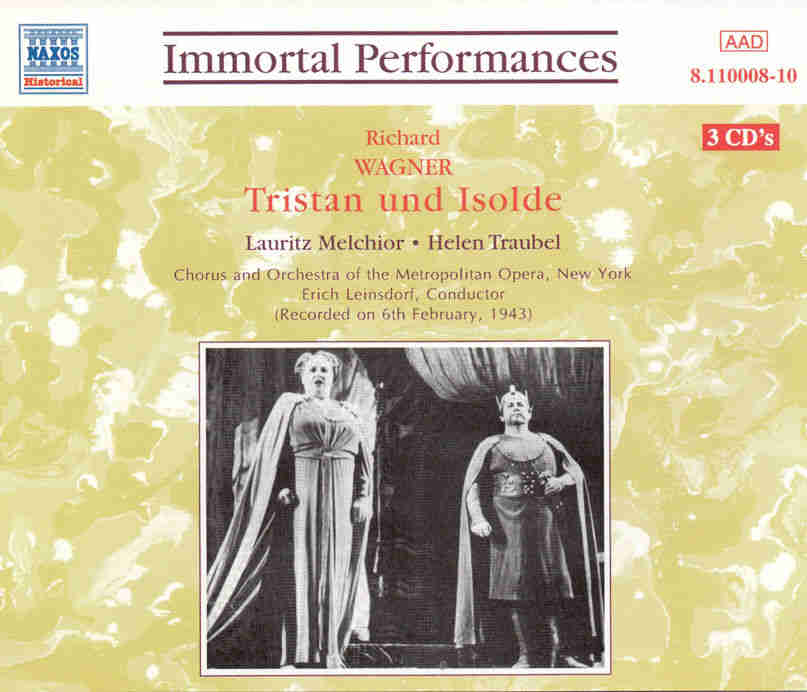
Tristan und Isolde

Erich Leinsdorf
New York Metropolitan Opera Chorus and Orchestra
Date/Location
6 February 1943
Metropolitan Opera New York
Recording Type
  live  studio
  live compilation  live and studio
Cast
TristanLauritz Melchior
IsoldeHelen Traubel
BrangäneKerstin Thorborg
KurwenalJulius Huehn
König MarkeAlexander Kipnis
MelotEmery Darcy
Ein junger SeemannJohn Garris
Ein HirtKarl Laufkötter
SteuermannJohn Gurney
Gallery
Reviews
Jonathan Brown

Like the 1941 recording, this one is superior to the forlorn 1940 recording, and brings us Helen Traubel’s Isolde for the first time (Flagstad had sailed from New York to join her husband in Norway). Traubel’s voice is lighter than Flagstad’s, not as steady and dark-hued, but this has its advantages. It makes the veteran Brangäne, Kerstin Thorborg, sound suitably mature and matronly as she advises Isolde on how to resolve her woes. And with her narrower tone, she appears more tense and more furious than Flagstad in pursuing Tristan: she assaults him at a different level. She is superb at some tender phrases (“Er soah mir in die Augen”), and her curse (“Tod uns beiden!”) is every bit as merciless as Flagstad’s, and has a deeply affecting twist of despair at Beiden.

In Act Two the contrast between the cautious Brangäne and the wayward Isolde works particularly well. But once caution is thrown to the winds and Tristan leaps on to the scene, Traubel avoids some high notes in the bewildering frenzy that follows. Thereafter the prompter can be heard at work. Alexander Kipnis is superb again as a most noble and deeply affecting King Marke, overcome by shame.

There is some “drop out” in the Prelude to Act Three and some serious surface noise, like a wind storm, which disturbs its tranquillity. The beautifully plangent car anglats is disturbed, yet again, by a dark ocean of coughing from the auditorium. Karl Laufkoetter makes his last appearance as the Shepherd, singing his “Öd und leer das Meer” with a delicate, trembling voice suggesting how much he dreads reporting his vision of a barren, empty sea. Melchior sounds utterly broken after cursing the drink (“Verflucht, wer dich gebraut!’). Whether feigned or real, this is the last we hear of him in a live performance. Leinsdorf adds one more cut to his usual three cuts to this Act, to spare Isolde for her Liebestod.

Jonathan Brown | Tristan und Isolde on Record

Classics Today

The 1940s were a luxurious time for Wagner singing, as this Met broadcast from February 6, l943, confirms. Erich Leinsdorf leads a tight performance, with overall quick tempos and severe cuts in Acts II and III, yet the tension remains high. The orchestra is in excellent shape and both leads are up to the unleashed sounds the players hurl at them. Melchior, of course, is a very well known quantity– here he uses his seemingly inexhaustible voice with color and thrust, and his final act is very moving. Helen Traubel was a singer of great strength as well, and the only thing she seemed to lack (besides a high C–she ducks them both here, as she invariably did) is the ability to nuance: Her Irish princess is long on nobility and scorn and a bit short on vulnerability. Kerstin Thorborg’s Brangäne is world class and Julius Huehn’s Kurwenal only just below that. Alexander Kipnis manages to avoid King Marke’s usual tedium and he never resorts to melodrama. The sound is quite good for its time and source. This set gives great pleasure.

Robert Levine | Oct 3, 1999

Rating
(8/10)
User Rating
(4.3/5)
Media Type/Label
Naxos, Arkadia, Line, IP, OOA
Get this Recording
Donate $5 to download flac
Technical Specifications
546 kbit/s VBR, 44.1 kHz, 656 MiB (flac)
Remarks
Matinee broadcast
A production by Joseph Urban (1920)
There are cuts in the performance the same as those in the 23 March 1940 performance, with the addition of a further cut in Act 3, Scene 2, from “Gebrochen der Blick!” to “Nur einmal noch!” (Isolde). [Jonathan Brown]