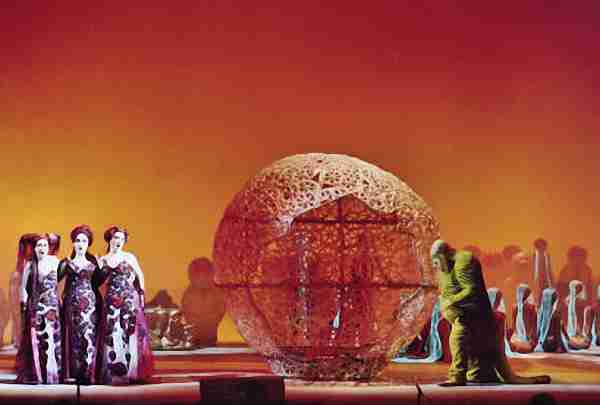
The Wales Millennium Centre’s operatic coup of the year – a four night performance of the Mariinsky Theatre’s 2003 Ring cycle and the only one in the UK – launched itself with a visually stunning Das Rheingold. Designed by former architect George Tsypin and with superb lighting by Gleb Filshtinsky, it is literally a riot of colour with its fairy tale sets and flamboyant costumes by Tatiana Noginova. The production has giants who look like Terry Pratchett’s trolls, Nibelungs straight from JK Rowling’s Gringott’s Bank and huge horizontal statues moving up and down over the stage to suggest Valhalla , Nibelheim and the Rhine. It’s a vast visual feast that doesn’t over-tax the intellect.
The ‘production concept’ as the programme describes it, is a joint effort by George Tsypin and Valery Gergiev. After reading a book on myths from Ossetia, the area of the Caucasus from which Valery Gergiev comes originally, George Tsypin writes that he ‘had this image of an amazing Ring which looks towards Asia, towards the Russian steppes. I had a sense of this ancient Russia – an almost archaic, barbaric percerption of that culture and I was very inspired… Wagner created something which it is really impossible to interpret and conquer within one neat concept.’
So he offers none. Apart from thinking about his production as a ‘Russian’ Ring, as an ‘art installation with amazing music’ George Tsypin makes no other interpretation of the text. The set is somehow ‘mythic’ and that is sufficient: the huge figures appearing in all four parts of the tetralogy may be giants or gods, he says, and there are four of them simply as a device with which spaces can be shaped or atmospheres created. The figures are ‘silent witnesses to this story’ , he adds, sometimes ‘doing nothing.. sometimes reacting with subtle movements to the stage action to indicate that they may have a cosmic’ (and therefore different) ‘perception of what is going on.’
What the floating statues made of it is anybody’s guess but human reactions to this Rheingold will be mixed. Some will complain that it offers nothing new, some will be puzzled by its ‘obscurity’ and others (like myself) will just have enjoyed the light show. The stage direction is minimal but it doesn’t lack good touches – there’s a convincing toad in Alberich’s second transformation and as the Gods enter Valhalla, they become multi-cultural deities, suggested by their headgear with Wotan as Anubis, the Egyptian dog-headed god. Asia may be nearer than we think as the rest of the cycle unfolds.
Opinions will vary on the music too since there was a noticeable Mariinksy (or Gergiev) sound to both playing and singing. It’s typically powerful, precise and colourful but close your eyes, forget that this is Wagner for a second and you could almost be listening to Mlada from time to time. No, that’s an exaggeration of course, but to my inner ear, the playing lacked Wagnerian feeling and atmosphere rather too much of of the time. Perhaps Russia and Wagner really don’t sit so easily together.
Similarly, while the singers were all uniformly competent as might be expected from this company – there were very few signs of vocal difficulty anywhere and the production has some extremely fine voices – it would be hard to maintain that much of what was offered amounted to great Wagner singing or characterisation. For the most part, it just sounded heroic and fairly relentless, as if (once again) the soul of both text and music was not quite being reached. Occasionally it was, (from Edem Umerov’s Alberich and Andrey Popov’s Mime especially) but hardly ever entirely so.
It was difficult not to make comparisons with other recent productions after this, particularly since it took place in Bryn Terfel country; and I came away oddly unmoved despite my pleasure from the set and lighting. Not quite pure Gold then, this Mariinsky Rheingold, though a very worthy Silver overall – and even a Silver Gilt now and then.
Bill Kenny | Wales Millennium Centre 30.11.2006




 (6/10)