
Tristan und Isolde

| Yannick Nézet-Séguin | |||||
| New York Metropolitan Opera Chorus and Orchestra | ||||||
Date/Location
Recording Type
|

| Tristan | Michael Spyres |
| Isolde | Lise Davidsen |
| Brangäne | Ekaterina Gubanova |
| Kurwenal | Tomasz Konieczny |
| König Marke | Ryan Speedo Green |
| Melot | Thomas Glass |
| Ein junger Seemann | Ben Reisinger |
| Ein Hirt | Jonas Hacker |
| Steuermann | Ben Brady |


Brilliant performances in the Met’s new Tristan und Isolde but staging gets in the way of the music
As far as well-known composers of opera go, Wagner stands out for a few reasons, not least of which being that he expressed very solid ideas – convictions – about what this art form actually is. He articulated his beliefs about opera no less vehemently when they happened to change. Tristan und Isolde has the privilege of evidencing the shift that occurred after Wagner’s reading of Schopenhauer, a philosophy that moved him away from his previous Gesamtkunstwerk orientation and towards recognition of music as the fundamental element of communication in opera, more primary than the words or stage action or scenery. And yet, music alone an opera does not make.
The Metropolitan Opera boasts the largest repertory house in the world, filled on Monday night by the promise of great music: Lise Davidsen earned tremendous praise for her debut as Isolde in Spain earlier this year, and conductor Yannick Nézet-Séguin also received glowing reviews for his concert performance of the score with the Philadelphia Orchestra last spring. The prospect of a transformative listening experience was enough for audiences keen to hear Michael Spyres make his role debut as Tristan and to brave director Yuval Sharon’s new production.
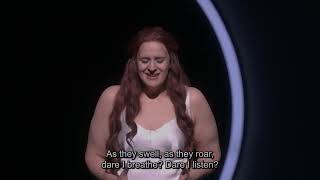
The world that Sharon places the story in is a very, very strange world. An aperture of sorts opens to reveal elevated cylindrical stages, reminiscent of the concrete vaults used beneath cities to keep utilities separate. Most of the singing is situated within these containers, sometimes lit with colors implying the mood. Between the cylinders and the pit, a sliver of stage features a table, initially attended only by a pair of dancer doubles.
As common as a table is, on the stage it feels forced, or even unwelcome. Much of the action around it seems superfluous or at odds with the story. The dancer couple pursue an intimate moment, abandoning each other right when the music intensifies; the king fondled pieces of a broken plate for eons. These small actions are projected, magnified, above the scene. It feels pedantic, even paternalistic, as if the audience cannot make a connection between ‘shattered’ trust, dreams, realities, without a sustained engagement with the shards. While some of the staging is creative, the most interesting parts compromise the singers’ projection, including that of Davidsen, the strongest voice in the cast and nearly always impeccable when not physically blocked by the set.
Lise Davidsen’s singing was dark and brilliant, a black diamond of a soprano. In the second act, there was even a moment when she transmuted the work into something more evocative of Hildegard, choosing to let her crescendo bloom rather than burst. If her performance was at all flawed, it was limited to parts of the third act, which at times felt mumbled compared to the phenomenal precision, reach and clarity she had displayed earlier.
Spyres proved to be a delightful casting choice, starting off somewhat gently, rising into the Act 2 duet, and delivering power, madness and sweet, trembling deep notes as Tristan thrashed against his oncoming demise. Tomasz Konieczny presented a strong, compelling Kurwenal. Aside from the power of his bass-baritone, his acting sustained a great interplay with the music, interpreting tension, worry and loyal brotherly love with both his posture and his singing.
Down in the pit, Nézet-Séguin kept a healthy pace with the Met Orchestra. There were a few passages with questionable dynamics, but it couldn’t have been more than a minute across four hours of otherwise excellent music.
One great challenge of Tristan and Isolde is that, while the music is primary, something does need to be put up on the stage. Minimalism and abstraction seem like philosophically correct directions. But there is a difference between the subtle and the vague, the serious and the austere, the domestic and the bizarre. It would be believable that Sharon had the intent of creating an experience that transcends the tale’s ancient origins, but he ultimately positions the story neither here nor there, yet still tangibly gets in the way of the music.
No’a L. bat Miri | 10 March 2026
Double trouble: Singers reach the heights in Met’s “Tristan”; staging, conducting not so much
Very little happens on stage in Tristan. Only Robert Ashley’s operas and perhaps Debussy’s Pélleas et Melisande are as minimal in terms of events, but extraordinary things happen in the music, and contra Sharon’s statement, that includes the singers. The opera is about characters transforming from one way of being to another (the fundamental drama in every opera), in this case, the princess Isolde (soprano Lise Davidsen) and the hero Tristan (tenor Michael Spyres), who through magic go from enmity to love, and through the music explore Wagner’s philosophical union of love and death as holy transformative experiences. The action, such as it is, comes from Tristan’s betrayal of King Marke (bass-baritone Ryan Speedo Green), meant to marry Isolde.
On paper, this is a drama so deeply rooted in ancient sensibilities that it could interest only anthropologists and literary scholars. But Wagner’s music, and how over the course of over four hours it is always processing through its own state to get to the final moment, is why this opera remains vital. And it was the performances of Wagner’s music in this production—specifically the singing—that delivered the drama Monday night. Less successful and consistent was conductor Yannick Nézet-Séguin, leading this work for the first time, and lastly Sharon’s staging, which was hit or miss (mostly the latter) all night.
The star of the night was Davidsen as Isolde. She delivered a stellar, often stunning performance. The easy power of her voice continues to astonish, and as Isolde she had a lustrous sound, full but not so much as to sacrifice clarity. That was essential to her characterization, which was based on superb diction and articulation, the mercurial emotions of the character coming through her voice. This was masterful operatic expression, sonically beautiful, the rise and fall of phrases and dynamics musically sumptuous, the quality of her vocal characterization changing along with the Isolde’s thoughts and feelings.
Davidsen also had rare vocal energy and charisma—which proved essential Monday night, as Nézet-Séguin got off to an underwhelming start. The opening Prelude, some of the most famous and revolutionary music in the history of opera, was far too slow to create the harmonic and dramatic tension that simply has to happen. The music was lovely, and the orchestra’s playing fine, as it grew more continuous, but Wagner’s ideas were missing. Davidsen’s vocal and dramatic power seemed to haul conductor and crew up to her level, and an hour of so into the work, at the next essential moment, her singing “Tristan” and Spyres responding “Isolde,” along with the orchestra, expressed everything in the opera.
In Act II, there was more warmth to start in Nézet-Séguin’s leadership, but far too little heat. Act III was fully satisfying from the start, though, the conductor seeming to finally hear what Wagner was doing.
Spyres was excellent. He has a richer sound than the typical Wagnerian tenor, free of strain. His phrasing was lovely, fluid, more natural sounding than one often hears in Wagner singing. Vocally, he had dignified diffidence at the beginning, then a deep passion from when the magic takes hold. He shared this with Davidsen, the sense of deep-rooted feelings driving their singing from the gut, an emotional strength that translated to a feeling of pure singing.
His stamina in Act III was impressive. Tristan dominates the act, singing almost continuously, and though there were moments that hinted at some fatigue, he found an even greater ease that seemed to open up more energy.
Mezzo-soprano Ekaterina Gubanova is Brangäne and bass-baritone Tomasz Konieczny is Kurwenal in this production. Both are experienced Wagner singers, and Gubanova’s showed immediately—this was an in-character opera performance through and through. Konieczny’s voice sounded a little tight in Act I, his phrasing abrupt, but in Act III’s intense moments with Tristan, he was smooth and warm.
Green is always a welcome sight on stage and was an exceptional King Marke, his performance as fine as Davidsen’s. He had the same easy way with his singing, a big sound with a small and pleasant touch of a rough edge. His delivery was commanding and deeply expressive, with real pain and anguish, great singing acting. His central Act II scene was also where Sharon’s staging had its finest moment, Marke circling the table as he sang about how Tristan betrayed him, fumbling with the pieces of a broken dinner plate, trying to fit them back together.
This could be seen viewed from an overhead camera and projected above the stage action. This is one of the features of the staging, projection and video design by Jason H. Thompson and Ruth Hogben that blows up what is happening on stage in real time, often freezing that into prerecorded still images. This can be striking, like in Act I, where Isolde holding a knife to Tristan’s throat morphs into a frame of the blade—fabulous lighting design by John Torres in his debut—that contains Davidsen and Spyre as they drink the magic potion.
That moment connects the two other features, which is that Sharon has a pair of doubles acting out certain moments in parallel and place of the real characters. The stage is defined by a giant iris that opens up into different shapes that frame the singers, including a tunnel that has some unpredictable megaphone effects. What these devices do is underline the drama without creating any additional context, as if Sharon has no personal opinions on Wagner and Tristan. And the stage doubles create new problems he can’t solve.
One is that even before the Prelude begins, a Tristan and an Isolde are already seated on stage, facing each other across a table. Music that emerges is undercut by a take-it-or-leave-it stage situation. In Act III, a Tristan double lays etherized on a table, dying, while Spyres sings his internal experiences from the tunnel. This is a brilliant device for getting at the core of opera’s purpose, and in another creative choice he’s joined by English horn soloist Pedro R. Diaz, in costume, playing the exquisite music of longing that runs through the act.
But this is also a trap that Sharon can’t get out of: while Spyres is in the tunnel, his interaction with Konieczny is awkward (as is Annie-B Parson’s choreography around him). Spyres also switches places with the double, back and forth, several times, and there’s no stagecraft to it at all—it is amateurish in context.
In a final, willful miscalculation, when Isolde returns, she’s pregnant, and when she dies it’s during childbirth. The registered effects are both gratuitous and superfluous, a director showing he has ideas but still doesn’t quite understand what opera is all about.
George Grella | Mar 10, 2026
Tunnel vision
Throughout the long evening, I repeatedly asked myself why this or that was happening. My frustration after the first Act grew as I struggled to discover coherence in a vision of the work that often felt random. I wasn’t surprised that Sharon’s lengthy program note is titled “Drowning in the Waves of the Universal Breath:” the result is actually a mostly traditional Tristan suffused with simple symbolism via complex contemporary technology. For example, as seen via the live video feed spanning the entire stage, the lover’s illicit connection was represented by a stark white dinner plate that, after it had been garlanded by violets, shattered at their discovery and which Marke helplessly tried to reassemble.
Sharon’s Tristan, like Charles Edwards’s hopeless I puritani which too included an inexplicable on-stage birth, turned out to be another instance of the Met failing its absolutely first-rate, world-class musical presentation. Last year Nézet-Séguin “tried out” Tristan with the Philadelphia Orchestra, another of his musical homes, and demonstrated that the work brings out the best in him.
If I were to choose, I’d say the Philadelphia performance orchestrally was finer than Monday’s which sometimes felt like a work in progress. The first-Act prelude failed to cohere and the remainder of that Act felt attenuated and the surefire excitement of its final moments chaotically sped toward intermission as Davidsen and Spyres (finally returned to stage level) did their best. On the whole, the Maestro’s Met tempi were slowish, sometimes to ravishing effect: the rapt “O sink hernieder” spun out with a bewitching glow by Davidsen and Spyres has rarely cast its spell so completely. By the third Act, however, Nézet-Séguin and his possessed orchestra were digging deeply into the mournful prelude, and they accompanied Spyres with stellar command leading to the work’s blissful final moments which—hurrah—were not interrupted by premature applause.
I’ve often been puzzled by complaints that Nézet-Séguin routinely covers his singers. For the past decade I have only heard his performances from seats in the orchestra, and I don’t recall a single instance when I couldn’t hear the singers, including Monday’s performance. However, a friend who was in the balcony for Tristan complained mightily that the sound barrage from the pit during the first Act covered everyone but Davidsen. The conductor ultimately tempered his dynamics going forward, but clearly where one sits at the Met drastically affects the balance between the stage and the pit. And, yes, as in Philadelphia, he took the traditional cut in the love duet which I regretted, but the third Act was done complete.
Gubanova who had been an uneven Venus in Tannhäuser at the Met in 2023 was again a persuasive Brangäne, but this time she sounded increasingly strained by the role’s high tessitura. And the long lines of her Watch revealed an alarming unsteadiness. As Sharon seemed little interested in Brangäne’s complex relationship with Isolde, Davidsen’s strong portrayal kept Gubanova pretty much in the background. Tomasz Konieczny had more luck as Kurwenal especially in the third Act when he provided the sole consistent element as Spyres and his double played musical tables. The bass-baritone who had been so appealing as Mandryka in last fall’s Arabella regained some of the unattractive snarl that had marred his Fidelio Don Pizarro, but he used his booming voice to smart effect in comforting the stricken Tristan and standing up to the lethal Melot of Thomas Glass.
Green’s first Marke was no doubt the most controversial portrayal of the premiere. His at-times gritty bass-baritone is much different from the rolling Germanic basses one usually hears as the King. However, his restrained yet intensely felt portrayal ably captured the monarch’s complex mixture of anger and sadness, and his security on high meant the climaxes of the monologue resounded easily. All in all, Marke suggested that Green’s ascension to Wotan in the new Ring (with a detour to Klingsor next season) may be more successful than his recent outings as Don Giovanni.
The astonishing versatility of Spyres continues to amaze: how many tenors have sung both their first Nemorino and first Tristan during the same season? That this Wagner debut succeeded should not, however, come as a surprise as the self-styled “baritenor” has in recent years taken on Lohengrin, Siegmund, and Walther, the last two bravely premiered at the composer’s own Bayreuth Festival. Any concerns that his pairing with the volcanic Davidsen might result in dire imbalance were almost immediately banished as they partnered so well together displaying enviable sensitivity and grace. There was no trace of “Bayreuth bark” in his healthy lyrical approach to Tristan and even the most challenging pages sounded remarkably bel canto.
Davidsen, capable of titanic high notes that are surely peeling even more gold paint from the Met’s proscenium, also brought exemplary sensitive dynamic subtlety to Isolde’s wide-ranging music. Her curse sizzled, her Liebestod surged. However, she looked uncomfortable in the low, narrow sloping capsule set for her first scene, and one imagines that she’ll bring more linguistic and dramatic variety to her portrayal as she continues exploring a part she herself admits she was born to play. Given that her Met commitments for the near future will be taken up with Lady Macbeth and the three Brünnhildes, one wonders when New York will next get another chance to experience her thrilling Isolde, already the best since….?
Christopher Corwin | March 12, 2026
Lise Davidsens Isolde-Show sorgt für Gänsehaut
An der Met füllt Lise Davidsens Leuchtkraftstimme Ränge und scheinbar Theaterkassen, Yannick Nézet-Séguins Dirigat begeistert Opernneulinge wie erfahrene Wagnerianer und Yuval Sharons Regie reiht sich in eine Serie an nichts aussagenden Met-Inszenierungen ein. Die sieben Tristane? Alle ausverkauft!
Ich könnte mich erstmal über Yuval Sharons emotionslose und akustisch nicht gerade sängerfördernde Tristan-Regie aufregen. Oder darüber, dass an einem der weltbesten Opernhäuser wieder mal kaum kritische Diskussion stattfindet. Das würde jedoch die Stimmung des Abends krachend verfehlen. Denn während die Mailänder Scala trotz Gala-Besetzung ihre Götterdämmerung kaum voll bekam, waren hier die sieben geplanten Vorstellungen dermaßen restlos ausverkauft, dass man vier Tage vor der Premiere spontan eine achte Matinee-Vorstellung am 4. April ankündigte. Allen fast 4.000 Plätzen zum Trotz. Die ganze Stadt fiebert für Wagner, für Tristan!
Die Met fiebert für Lise…
…und die Met liebt überhaupt alles, was man ihr auf die Bühne stellt. Trotzdem, dieses in der Opernwelt wohl einzigartige Applausfeuerwerk war für Lise Davidsens Sopranpowerhouse mehr als verdient! Wie freischwebend füllte ihre mächtige Stimme den enorm großen Zuschauerraum, kraftvoll versetzten ihre Einrufe „Tristan! Geliebter!“ einen selbst in den obersten Rängen in Gänsehautstimmung.
Spätestens mit ihrem Liebestod hatte sie die Konkurrenz völlig von der Bühne, nein, mindestens aus der Stadt gefegt und sich unangefochten zur New Yorker Wagner-Königin des Jahrhunderts gekrönt. Man fiebert schon jetzt ihrer Lady Macbeth und Brünnhilde entgegen… und mit am lautesten dürfte wohl Peter Gelbs Kassenwart über diese Lise-Davidsen-Show jubeln!
Koniecznys Kurwenal räumt ab
Die zweite Sensation des Abends war Tomasz Koniecznys Kurwenal. Ich habe in dieser Rolle schon viele gute Sänger gesehen, aber das, was der einst thronende Wotan in dieser Rolle bot, war einzigartig. Mit Inbrunst ließ er die Gefühle seiner Partie siegessicher von der Bühne strahlen, holte aus den Melodien bislang gänzlich unentdeckte Emotionen heraus. Auch Ekaterina Gubanova sang die Brangäne mit viel Liebe und Tiefe. Völlig unbeeindruckt zeigte sie sich von Frau Davidsens deutlich voluminöseren Lautstärke und stand ihrer Herrin musikalisch um nichts nach!
Ryan Speedo Green war ein mindestens sehr guter König Marke. Sein röhrender Bass rezitierte die Monologe klar und kraftvoll und setzte dieser sehr statisch komponierten Rollen einige herrschende Akzente. Die Nebenrollen waren alle sehr stark besetzt, vor allem Ben Reisinger als Junger Seemann macht mit viel Präsenz deutlich auf seine kraftvolle Stimme aufmerksam!
Spyres’ Tristan-Debüt mühelos
Ein wenig kampflos stellte sich Michael Spyres seinem Tristan-Debüt entgegen. Zwar sang er die wohl schwerste Opernpartie aller Zeiten erstaunlich mühelos, doch schien er den emotionalen Kraftakt des dritten Aufzugs nicht wirklich anpacken zu wollen. Als wäre es nicht sein Konzept, sich von diesem Liebeskummer mitnehmen zu lassen. Muss man einen Tristan unbedingt laut, laut und noch lauter singen? Nein! So wirklich umgehauen hat mich das trotzdem nicht. Eine technisch mindestens überragende Leistung, seine Paraderolle wird das fürs Erste wohl nicht werden.
Nézet-Séguin entschlüsselt die Partitur
Einen besonders starken Abend hatte dafür Yannick Nézet-Séguin am Pult des Hausorchesters. Seine Leitung setzte der Partitur viele frische Akzente, hielt den Spannungsbogen vom ersten bis zum letzten Takt aufrecht und riss das Publikum in den Bann dieser Musik. Vielleicht nicht die tiefgründigste aller Interpretationen, macht nix. Im Gegenteil, sein überaus lebhaftes Dirigat entschlüsselte die hochkomplexe Partitur samt all ihren Emotionen. Ein paar Gäste waren das erste Mal in der Oper, und dann Tristan, puh! Herr Nézet-Séguin nahm die Neulinge und alten „Opernhasen“ gleichsam berauschend mit, das war entsprechend eine dirigatstechnische Meisterleistung,
Yuval Sharons Regie fasst die Liebe nicht
Und nun zur erwähnten Regie: Diese regelrecht sängerunfreundliche Direktion von Yuval Sharon war ein Totalausfall. Die meiste Zeit verbrachte das Liebespaar inmitten eines riesigen, von Ozeanwellen umgebenden Auges, das gleichzeitig an ein überdimensioniertes Guckloch auf einem Ozeanriesen erinnerte. Schön und gut, frisch weht der Wind der Kreuzfahrt zu. Nur klang auf diesem akustischen Podest selbst Frau Davidsens Leuchtturmstimme hörbar gedämpft. Dazu ein paar Kostüme direkt aus dem Mittelalter und kaum Personenregie. Das einzig interessante passierte völlig jenseits des Blickfelds, als wollte Herr Sharon Tristans und Isoldes Liebe gänzlich aus den Augen verschwinden lassen anstatt sie zu fassen…
Wagner fordert seine Sänger bis an ihre Grenzen und darüber hinaus. Eine Tristan-Regie sollte mit und nicht gegen die Sänger arbeiten. Oder gehören diese sehr zahlreichen nichts aussagenden Inszenierungen neben den überragenden Stimmen zur Met-Experience? Und warum hält eigentlich Marke in der Schlussszene Isoldes Kind im Arm? Was kommt denn als nächstes, Hunding als Vater Siegfrieds vielleicht? Achso, den nächsten Met-Ring hat man Herrn Sharon ja schon anvertraut…
Johannes Karl Fischer | 10. März 2026

 (5/10)
 |
A production by Yuval Sharon (premiere)
Michael Spyres’ debut as Tristan