Der fliegende Holländer

| Martijn Dendievel | |||||
| Coro del Teatro Municipale di Piacenza Orchestra dell’Emilia-Romagna | ||||||
Date/Location
Recording Type
|

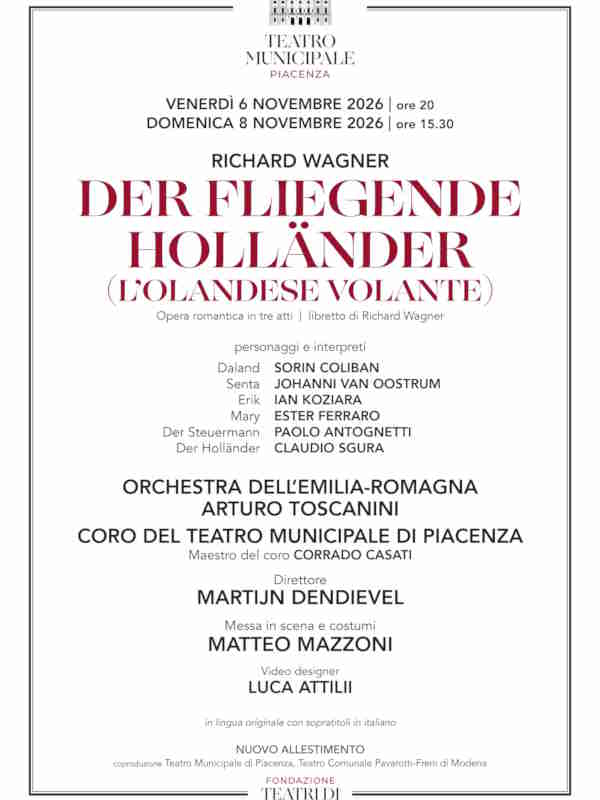
| Daland | Sorin Coliban |
| Senta | Johanni van Oostrum |
| Erik | Ian Koziara |
| Mary | Ester Ferraro |
| Der Steuermann Dalands | Paolo Antognetti |
| Der Holländer | Claudio Sgura |
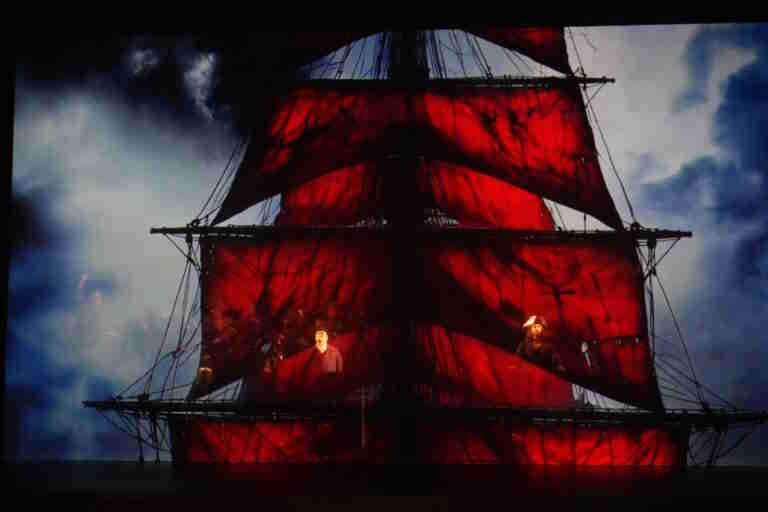
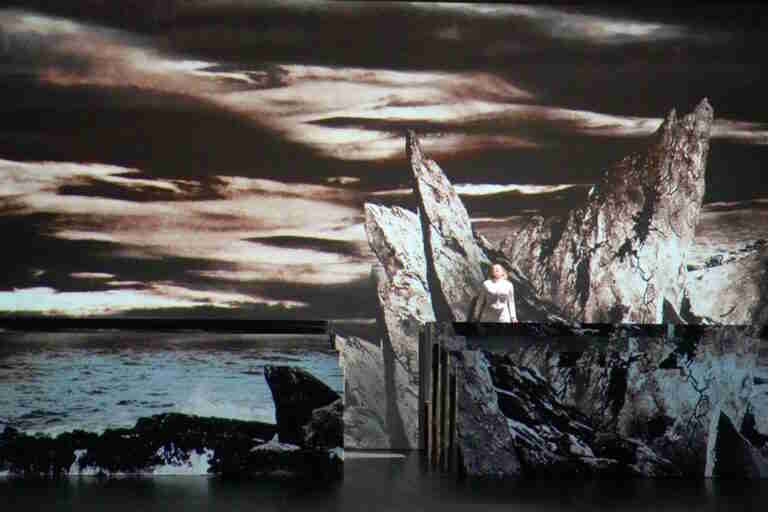
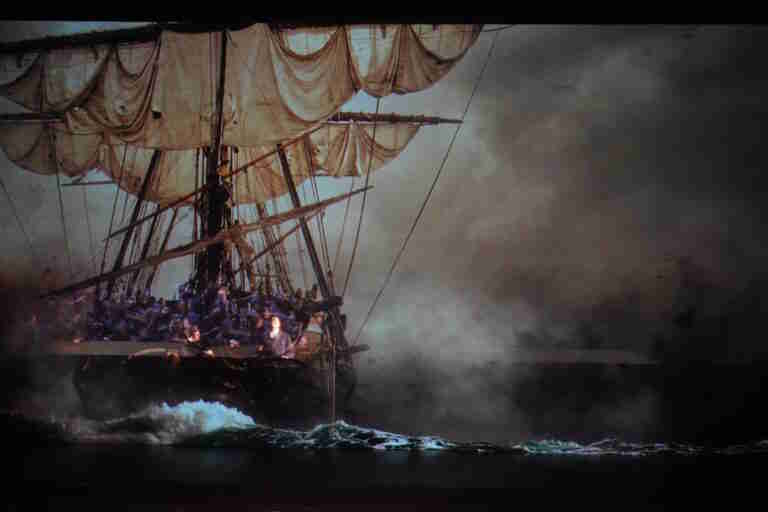
It came as little surprise to find “Der fliegende Holländer” in Teatro Municipale di Piacenza’s program as the closing production of the 2025-26 season. Due to technical and organizational reasons related to the staging, “Lohengrin,” also by Wagner, originally scheduled for 6 and 8 November 2026, was replaced by “Der fliegende Holländer.” The theater’s management opted to retain a Wagnerian work within the current opera season, thus ensuring continuity in the artistic project.
Wagner is not a frequent presence in the programming of Italian opera houses, making the debut of this opera in Piacenza all the more successful. Composed between 1841 and 1843, “Der fliegende Holländer” presented 150 years after its Italian premiere and never before performed in Piacenza, marks a decisive stage in the evolution of the repertoire of Italian opera houses.
Wagner draws upon the myth of the Flying Dutchman, one of Europe’s most celebrated maritime legends. Its protagonist is a Dutch captain condemned to sail the seas for eternity, although he is granted one possibility of escaping the curse: every seven years, he is allowed to come ashore in search of a woman capable of loving him with absolute fidelity until death. Finally, having won Senta’s love, the Dutchman is released from his condemnation, and the two are reunited in death and redemption.
A man without an Ithaca, without a Penelope waiting for him, without the certainty of finally being able to return home. This is how stage director Matteo Mazzoni explained the true curse of the Flying Dutchman. For the Italian creative artist, the curse is something more than a condemnation: while Ulysses crosses the sea to rediscover the place to which he belongs, the Dutchman is condemned to sail because that place no longer exists, or perhaps never existed.
Production Details Astonishing Realism
Starting from this premise, Mazzoni signs what might be the finest production at the Teatro Municipale di Piacenza to date. It is a new staging co-produced with the Teatro Comunale di Modena. One of the production’s major achievements is the work of video designer Luca Attilii, who brings Mazzoni’s vision to life with remarkable clarity through videos and animations of the highest quality.
The result is a stage picture of astonishing realism, capable of creating a striking effect from the very moment the curtain rises. With ingenious, highly discreet black platforms, on which the chorus members appear, the animations depict the approach of the great ship through projections, while Daland’s sailors suddenly emerge within the animated images, aboard their respective vessels. The illusion is perfect: it looks like a film, but one unfolding live before our eyes. The projections are not limited to the Dutchman’s ship; they also build dramatic tension through the turbulent sea, paradise, the cloud-filled sky and the two vessels that repeatedly confront one another. Everything comes to life with a naturalness rarely achieved through projections. In reality, there is no physical scenery, but nothing more is needed.
Mazzoni’s talent does not end there. He is also responsible for the costumes and lighting. The costumes, classical in style and paradoxically in keeping with the staging itself, stand out for their beauty, although they resort to certain clichés. Daland wears the traditional attire of a northern European sailor; Senta appears in an immaculate white dress; and the Dutchman wears the typical pirate outfit, entirely in black, with high boots, a hat and an open-chested shirt. Combined with the lighting design, these elements create a ghostly, mysterious atmosphere that envelops the audience from the very beginning.
Conductor Martijn Dendievel Highlights
In the pit, the result was even more surprising. Martijn Dendievel‘s conducting came close to perfection. From the overture, with the storm unleashed in the orchestra and the Dutchman’s theme played at full volume by the brass, one could sense that this would be an extraordinary performance: and so it proved. The Belgian conductor demonstrated a profound command of the Wagnerian style and great sensitivity in the more melancholic passages, such as Senta’s theme and the opera’s finale.
At the same time, Dendievel knew how to draw extraordinary results from the Orchestra dell’Emilia Romagna Arturo Toscanini, whose musicians responded attentively to his indications and delivered a performance of a very high standard. The contribution of the Coro del Teatro Municipale di Piacenza, under the direction of Corrado Casati, was equally successful.
Claudio Sgura as The Dutchman
Claudio Sgura as the Dutchman was particularly impressive in his role debut. The Italian baritone approached the part with great seriousness and achieved excellent results. His voice was ample, and his dark timbre was well suited to the tormented nature of the character, whom he portrayed with authority. He was always fully in character, irascible and mysterious, just as one might imagine of a cursed pirate who no longer expects anything from life. His appearance from the darkness inspired a certain degree of fear. It was a highly convincing interpretation from a baritone who was equally comfortable with both the stage direction and the musical demands of the role. His vocal line was consistently clean with a powerful timbre and clear diction.
Johanni van Oostrum as Senta
Johanni van Oostrum portrayed Senta with a beautiful timbre, well-supported high notes and elegant phrasing, all of which completed her performance. The South African singer’s voice possessed a lovely color and a carefully shaped vocal line; her interpretation was imbued with the appropriate character. Particularly noteworthy was the strength of her upper register, consistently in tune and of outstanding quality, as well as her commitment in the moments of greatest intensity.
The duet with the Dutchman reached a high level of dramatic and emotional intensity: a sense of despair could be perceived in her voice, arising from a highly accomplished interpretation shaped by the stage direction.
Sorin Coliban as Daland
Sorin Coliban was also very successful as Daland. His low register was solid and well-colored. He built his character with just the right balance of paternal warmth and greed. From the beginning of the opera, he impressed with a robust, dark and powerful vocal presence of excellent tonal quality. His appearance in the opening scene was striking. His German diction was exceptionally clear, and his acting was fantastic. The Romanian bass-baritone portrayed a highly jovial Daland, supported by a smooth, well-timbred voice.
Ian Koziara as Erik
Ian Koziara as Erik was competent, managing to give particular prominence to a somewhat secondary role. His acting abilities were especially notable in conveying the tragic torment of incomprehension. He constantly lamented, moved and gestured in a physical performance that contributed to conveying his anxiety. Vocally, he offered a clean vocal line with considerable interpretative ability and quality. Wagnerian repertoire is probably not the most suitable choice for his vocal characteristics. It would be interesting to hear him in a lighter repertoire, such as Mozart or bel canto. Nevertheless, his performance was more than adequate.
Illuminating Cast
Special mention must be made of Paolo Antognetti‘s Steuermann, whose bright, secure voice turned his Act one song into a little gem. His interpretation was rich in effects, with effortless, full-bodied high notes. The result was a truly beautiful contribution, despite the brevity of the role.
Mezzo-soprano Ester Ferraro as Mary displayed consistent stage confidence and vocal poise.
At the end of the performance, the success was resounding, with an exceptionally prolonged applause. The audience offered a warm and enthusiastic reception during the curtain call, which continued until the very last moment, making its satisfaction abundantly clear. A major round of applause is also due to the theater for bringing the season to a magnificent close.
Bernardo Gaitan | Nov 11 2026
This Der fliegende Holländer is the last production in the house’s 2025 – 26 season, before the new operatic year opens next month with a new production of Siberia. For this final show of the season, the house has presented an international cast, featuring singers who regularly frequent some of the world’s most eminent theatres, all under the direction of the exciting young Flemish conductor, Martijn Dendievel. The house itself is an absolute jewel. To be able to hear Wagner’s score in such an intimate space was certainly a treat and the performance standards are generally of a strong level.
The staging was confided to Matteo Mazzoni, with video designs by Luca Attilii. They give us an intelligent solution to being able to present such a phantasmagorical work in an efficient, and also presumably cost-effective, way. Attilii’s projections are used to cover the entirety of the proscenium, making it actually look like the Holländer is appearing from the waves and that the crews of seamen are indeed on the boat. The set is extremely basic, consisting simply of rows of choir pews, where the chorus sings, while also giving them the facility to use the score as they dispatch the music. What Mazzoni and Attili do very much succeeds in amplifying the ideas of the score, bringing out its fantasy and otherworldliness, thanks to the video projections that are as integral to creating the characters as the principals themselves.
That said, not quite everything works. I’m not quite sure what the two sirènes in red ball gowns were dancing around the stage for – they looked rather out of place in such a maritime environment, though they were clearly not Scotswomen since their gyrations also included what appeared to be a slow-motion cancan. Perhaps it was a way to make use of the house’s ballet. The personenregie also consisted of a considerable amount of time spent parking the principals at the front, with arms outstretched, while moments of great importance were marked with them descending to their knees. Similarly, I don’t quite see why Senta’s ballad included her indulging in what appeared to be slow-motion Pilates movements, but I’m sure it was useful for her vocal production. Perhaps as a consequence of needing to use the score, the chorus was placed in the rows while occasionally indulging in some random arm movements that seemed aleatory and inconsistent. It’s a shame the personenregie was so perfunctory because the staging itself looks good and it really does make the story come to life visually. The most positive aspect of the direction of the principals is that they most certainly engaged with each other and were clearly differentiated characters.
Dendievel led a vigorous reading that was generally very well paced. The start of that celebrated overture was most striking: icy strings bringing that cold maritime air, heroic horns invoking life on the high seas, all combined in this most immediate acoustic with an exhilarating rhythmic dynamism that just pulled the listener in. He obtained some very good playing from the orchestra, the odd bit of scratchiness in the strings in the faster figures at the close of the overture, or a few small brass accidents along the way, were very much passing moments. I did find his pacing of the first half of the Senta/Holländer duet to be somewhat on the luxurious side, although it was very well supported by the principals – and again, this was very much an exception in a reading that was visceral and exciting. Dendievel also succeeded in keeping his forces fully together in ‘Steuermann, laß die Wacht’ in what must have been very tricky circumstances given that the chorus was obscured by the projections and I wonder how much of him they were able to see. It was obvious from the clarity of his gestures to them that they were fully on board with the direction set from the pit. This is only Dendievel’s second Wagner, after a Lohengrin in Sofia before the summer that sadly I was unable to get to. I very much look forward to seeing more Wagner from him in due course.
Claudio Sgura was an intriguing piece of casting in the title role. Having seen him as an utterly musical and aristocratic Scarpia in both Naples and Florence, I was keen to see him take on a very different assignment. Sgura has clearly worked very hard at internalizing the role and familiarizing himself with the language. It’s a role that sits well in his dark, velvety baritone and the tessitura was negotiated with confidence. As a singer of the Italian school, Sgura’s vocalism privileges the line and legato over a text-forward approach, and this made his Holländer much more focused on beauty of tone rather than illustrating the character through the text – although the words were frequently perceptible. That said, his stage presence made the haunted, almost neurotic, nature of his character most realistic and his was an interesting take on the role.
His Senta was Johanni van Oostrum. She’s a natural stage animal and, combined with her significant experience of singing Wagner’s music, brought an energizing effect to the stage. Her soprano has creamy chalkiness to the tone, with a focused burst of vocal energy, all combined with the easy top that this role requires. Van Oostrum kept the text constantly forward, making the words live, so that her singing became utterly compelling thanks to that explicit union between word and action. Erik was sung by Ian Koziara. He made a genuine attempt to sing with long, legato lines, in so doing giving us a very classy piece of singing. His tenor has a rich lower register, while the top does have a tendency to become paler and taper off. The voice is, however, a very good size and his diction impeccable.
Sorin Caliban took a little while to find his optimal form as Daland, the voice initially slightly grey. He very quickly found his feet, his bass emerging with generous resonance and silky tone. As Mary, Ester Ferraro was a very welcome surprise. The owner of a sunny mezzo she also has excellent sung German. Paolo Antognetti sang the Steuermann in a warm, handsome and forwardly-placed tenor. The chorus, prepared by Corrado Casati, sang with lusty enthusiasm, with the tenors and basses giving some delightfully uninhibited and rustic singing. The sopranos and mezzos featured some very confident contralto singing, while their tuning in the spinning chorus was strikingly accurate.
Today’s Holländer gave much to enjoy. The staging was visually intriguing and offered several striking stage pictures. The singing was always honourable with performances from the principals that were vibrant and deeply felt. Getting to hear this score in such an intimate house was a real treat and Dendievel led a vigorous and exciting reading, ensuring a unanimity of approach between stage and pit. The audience response at the end was warm and generous for the entire cast. While this was the final performance of two in Piacenza, the cast will be decamping to the Teatro Pavarotti-Freni in Modena for two further performances later this month.
Teatro Municipale di Piacenza – November 8th, 2026
Sul vascello dell’Olandese
Wagner nelle terre di Verdi si può fare. Ci crede e, soprattutto, lo dimostra Cristina Ferrari, nostra Signora del Teatro gestito come Dio comanda, sacerdotessa del Municipale di Piacenza, casta diva che inargenta ogni stagione farnesiana con passione e senno, facendo del suo gioiellino un inevitabile e quanto mai scomodo termine di paragone nell’agone operistico nazionale, con buona pace di teatri più blasonati, più ricchi e meno illuminati che da questa virtuosissima provincia avrebbero parecchio da imparare. Quest’entusiasmo alle stelle, sia chiaro, non è frutto di un’improvvisa vocazione all’agiografia teatrale, ma dell’ennesima prova di forza del Municipale, che si concede il lusso di chiudere la stagione lirica 25/26, qui dove Verdi non è un cognome ma un Verbo, con Der fliegende Holländer di Richard Wagner, mai approdato prima d’ora a Piacenza, quasi che il marinaio maledetto avesse dovuto attendere due secoli per trovare il coraggio di sfidare i fedeli del Maestro di Busseto. Una sfida vinta a mani basse, a giudicare dal successo calorosissimo tributato allo spettacolo, che dimostra come anche Wagner possa trovare ospitalità e fortuna tra pance avvezze a coppa e cabalette. Certo, L’Olandese, ancora legato alle forme dell’opera romantica, tra arie, duetti e cori, è forse uno dei titoli più facilmente digeribili del catalogo wagneriano, ma sarebbe ingeneroso ridurre a una questione di appetito musicale il trionfo di una produzione che ha saputo conquistare il pubblico al di là delle più rassicuranti abitudini di repertorio.
Merito, innanzitutto, è dello spettacolo firmato da Matteo Mazzoni, che in locandina è indicato, con un afflato di rara umiltà, quale responsabile della «messa in scena», definizione che suona quasi come una diminutio rispetto alla più altisonante «regia» – come se tutte le regie, o le sedicenti tali, fossero sempre più di una mise en scène. Non è ben chiara la ragione di tanta modestia: forse perché la vicenda è raccontata, tutto sommato, per quello che è, senza cervellotiche involuzioni drammaturgiche né enigmi da sottoporre all’esegesi dello spettatore, affidandosi piuttosto a un segno visivo di indubbia suggestione, che impreziosisce lo spettacolo senza mai risolversi in un esercizio estetico fine a sé stesso. Eppure, nella sapienza con cui Mazzoni costruisce l’azione, nel gusto squisito della narrazione, nella furba gestione delle masse, si riconosce proprio quell’arte del raccontare che, secondo chi scrive, dovrebbe costituire la ragion d’essere di ogni autentico teatro di regia, quale che sia la strada interpretativa che si scelga di percorrere. A dare corpo e sostanza a questo universo marinaro sono soprattutto le splendide videoproiezioni di Luca Attilii, che dilatano lo spazio scenico fino a confonderne i confini, in un continuo gioco di trasparenze, sovrapposizioni e prospettive. Grazie a un ingegnoso impiego dei praticabili collocati dietro le superfici di proiezione, i marinai sembrano davvero solcare le onde, ora inghiottiti dalla vastità del mare, ora restituiti al proscenio, in un’alternanza di primi piani e visioni d’insieme di grande efficacia. Ne nasce un affresco di straordinaria forza evocativa, nel quale la tecnologia non si limita a illustrare l’azione, ma concorre a darle respiro, profondità e movimento, accogliendo il pubblico sul vascello dell’Olandese e richiamando a tratti le atmosfere avventurose di un film della saga Pirati dei Caraibi.
In effetti, nulla ha da invidiare a Johnny Depp l’Olandese di Claudio Sgura, al debutto nel ruolo: due metri di baritono dall’aria dannatamente maledetta, autorevole, carismatico, potente e tormentato, con una voce educata dalla scuola di canto italiana e piegata in ogni momento alle esigenze dell’espressione, chiamato a dar vita a un protagonista che, attraverso un fraseggio vario, incisivo e sottilmente inquietante, restituisce tutta la gelida alterità di una creatura avvolta in un’aura di spettrale immaterialità. La sua amata è Johanni van Oostrum, Senta di indubbio fascino: il timbro è bello e pieno, l’interprete presente e partecipe all’ostinazione visionaria della giovane ossessa, in una prova di viva intensità, appena velata da qualche opacità nell’acuto estremo, che non ne compromette tuttavia la felice riuscita complessiva. Sorin Coliban è un Daland di solida caratura vocale, forte di un timbro corposo e ben tornito, cui accompagna una caratterizzazione scenica felicemente sospesa tra bonomia paterna e opportunismo mercantile. Ian Koziara affronta con bella sicurezza la parte di Erik, valorizzandone gli slanci lirici con canto sorvegliato e fraseggio convincente. Molto valido il Timoniere di Paolo Antognetti, che sfoggia una voce fresca, squillante e ben proiettata, mentre ottima è la prova di Ester Ferraro, capace, nelle poche battute affidate a Mary, di suscitare il desiderio di ascoltarla presto in ruoli di ben altro respiro.
A meritare una menzione specialissima è però Martijn Dendievel, cui si deve una concertazione di assoluto pregio, che restituisce all’Olandese tutta la ricchezza di una partitura ancora sospesa tra le seduzioni del melodramma romantico e le vertigini del dramma musicale a venire. La sua bacchetta sa essere febbrile senza diventare concitata, appassionata senza indulgere al sentimentalismo, impetuosa senza mai confondere la potenza con il volume, in una lettura che trova nella mobilità del fraseggio e nella raffinatezza del colore orchestrale le proprie virtù più preziose. Ne nasce un Wagner di sorprendente eloquenza, nel quale il canto conserva sempre il proprio primato e la trama sinfonica, lungi dal farsi semplice commento, sembra respirare insieme ai personaggi, assecondandone inquietudini, slanci e abbandoni. Tanto più notevole è il risultato perché a rispondere a tanta intelligenza musicale è l’Orchestra dell’Emilia-Romagna Arturo Toscanini, formazione che non ha certo in Wagner il proprio pane quotidiano e che pure, sotto la guida di Dendievel, sfoggia una qualità esecutiva di tutto rispetto, per coesione dell’insieme, precisione degli attacchi e solidità della tenuta orchestrale. C’è infine il Coro del Teatro Municipale di Piacenza che Corrado Casati, destinatario di personalissimi apprezzamenti alle uscite finali, ha preparato con tanta cura: riscopriamo una compagine compatta, vigorosa, ispirata, quasi ingolosita da tanto bendidio in partitura, che rende piena giustizia a quell’ulteriore, formidabile personaggio collettivo cui Wagner affida un ruolo di tutt’altro che secondario nell’economia musicale e drammatica dell’opera.
Alla fine dell’opera i cori sono quasi da stadio – giuro, non stiamo esagerando –, con un pubblico che sembra aver dimenticato ogni antica diffidenza verso il compositore di Lipsia e acclama a gran voce tutti gli artefici dello spettacolo, a dimostrazione che, quando le cose si fanno per bene, persino nelle terre di Verdi si può diventare wagneriani senza bisogno di abiurare.
Antonino Trotta | 10 Novembre 2026
L’Olandese volante atterra (finalmente) a Piacenza
Il “facile” titolo di questa recensione si giustifica con l’altrettanto naturale sorpresa generata dall’apprendere che Der fliegende Holländer di Richard Wgner approda al Teatro Municipale di Piacenza per la prima volta dalla sua prima messa in scena, avvenuta a Dresda 183 anni fa. A essere sinceri, la cosa ci stupisce fino a un certo punto, non tanto per il “ritardo” piacentino, ma soprattutto per la tendenza che questo ritardo – seppure indirettamente – denuncia. Vale a dire una sorta di ormai congenita (patologica?) inerzia generale che possiamo registrare nella programmazione operistica nazionale: l’usato sicuro rappresentato da titoli molto popolari (Verdi e Puccini, certo, ma non solo) versus varie “novità”, alcune delle quali vecchie, appunto, di quasi duecento anni.
In ogni caso, onore al merito per la Direzione artistica di Cristina Ferrari e la sua squadra, capace di dimostrare che anche un “teatro di tradizione” – definizione nobilissima, la cui attività è fondamentale per il fecondo radicamento della cultura musicale del nostro Paese – può fare scelte coraggiose e, assieme, consapevoli misurando risorse, organizzazione, visione artistica e collaborazioni, unendo il tutto in una proposta originale e di qualità.
Detto questo, veniamo quindi a questo nuovo allestimento di Der fliegende Holländer, che nasce da una coproduzione fra il Teatro di Piacenza e il Teatro Comunale Pavarotti-Freni di Modena. Martijn Dendievel è alla guida dell’Orchestra dell’Emilia-Romagna Arturo Toscanini e del Coro del Teatro Municipale di Piacenza preparato da Corrado Casati, mentre Matteo Mazzoni firma regia e costumi, con Luca Attilii impegnato nella cura delle efficaci videoproiezioni.
Ispirato ai Memoiren des Herren von Schnabelewopski di Heinrich Heine e al viaggio per mare dalla Prussia orientale a Londra compiuto dallo stesso Wagner nel 1839, questa pagina – composta fra il 1840 e il 1841 e proposta per la prima volta appunto a Dresda il 2 gennaio 1843 – si presenta come un’opera romantica in tre atti su libretto dello stesso compositore, collocandosi in una fase di trasformazione del suo linguaggio.
In merito alla messa in scena, sono i propositi dello stesso Mazzoni a offrire un’utile chiave interpretativa: il regista, infatti, considera la maledizione dell’Olandese una condizione esistenziale, prima ancora che una condanna soprannaturale. Nella visione del metteur en scène, il protagonista diventa quindi una sorta di figura emblematicamente priva di approdo, impegnata a cercare qualcuno di fronte al quale (o alla quale) abbandonare le proprie difese alla ricerca di una qualche redenzione. A differenza della figura rappresentata da un altro viaggiatore mitico – e ultimamente molto à la page – come Ulisse, l’Olandese però non ha una casa o una famiglia alla quale ritornare.
Il centro della narrazione si sposta, dunque, dal viaggio in sé verso un percorso che conduce il protagonista ad affidarsi a un’altra persona, facendo della fiducia il fulcro nodale della vicenda. Una prospettiva, questa, che rende riconoscibile l’intenzione di avvicinare il racconto wagneriano alla precarietà dei legami contemporanei, mitigandone forse l’afflato più immaginifico e spettrale (come ci ricorda, in tutt’altro contesto, il buon vecchio capitano Jack Sparrow, alla fine si tratta pur sempre di storie di pirati e di fantasmi…).
Su questo sfondo, la lettura proposta da Dendievel pare essersi concentrata su un’efficace coesione del racconto musicale che ha confermato la reattiva compagine orchestrale quale co-protagonista della vicenda, con la caratteristica fascinazione tratteggiata dagli scarti timbrici e dinamici che innervano lo scorrere della partitura qui plasmata dal direttore con gesto al tempo stesso pregnante ed essenziale. Un segno capace di articolare la forza evocativa scaturita dal passo drammaturgico-musicale senza sacrificare le esigenze del canto, sapendo inoltre gestire un coro non sempre ritmicamente a fuoco.
Sul palcoscenico una compagine vocale ben assortita, a partire da Claudio Sgura, al debutto nel ruolo dell’Olandese, che ha restituito un protagonista dalla solida presenza vocale e scenica, affiancato da Johanni van Oostrum nei panni di una Senta sicura ed efficace, nutrita dall’esperienza wagneriana maturata da questa interprete, e da Sorin Coliban, interprete capace di tratteggiare un Daland ottimamente definito. Bella consapevolezza è emersa inoltre anche nelle prove di Ian Koziara (Erik), Ester Ferraro (Mary) e Paolo Antognetti (il Timoniere). Un cast salutato in occasione della “prima” dai calorosi e meritati applausi del pubblico presente, ribaditi anche per la regia di Mazzoni e per la direzione di Dendievel.
Alessandro Rigolli | 09 novembre 2026
Mehr als 180 Jahre hat es nun gedauert, bis das Teatro municipale di Piacenza den Mut aufbringt, dem heimischen Publikum Richard Wagners fliegenden Holländer vorzustellen. Das ist umso lobenswerter, da Wagners Werke auf den Bühnen südlich der Alpen nicht halb so präsent sind wie hierzulande. Die in Koproduktion mit dem Teatro Comunale Pavarotti-Freni di Modena entstandene Produktion wird vor allem dank der Videoeinspielungen von Luca Attilii zum bejubelten Erfolg – und musiziert wird auch nicht schlecht.
Schlicht genial muss man die Komposition der Videos, mittels derer Luca Attilii ganze Schiffe auf die Bretter der Bühne in Piacenza bringt, nennen. Sie werden in weiten Teilen auf eine Gaze projiziert; dadurch entsteht die Illusion, dass die Personen dahinter sich in den gezeigten Videos befinden. Ein phänomenaler Effekt! Kulissen im eigentlichen Sinne gibt es dagegen kaum und auch von Regiearbeit mag man bei Matteo Mazzonis allzu statisch wirkender Umsetzung fast nicht sprechen. Wenig Interaktion zwischen den Protagonisten, stattdessen viel Herumgestehe und opernhaft-simple Gesten zum Gesang: vielleicht hatte der aus Jesi stammende Regisseur Bedenken, dass zu viel Aktion in Kombination mit Attiliis gefilmten Bildern die Inszenierung überfrachten könnten – aber bewegen hätte er sich die Sängerinnen und Sänger doch lassen können. Sei‘s drum – der Abend gelingt auch ohne ausgefeilte Personenregie und so kann sich das Sängerpersonal zumindest auf den Sangespart konzentrieren. Denn der gerät mehr als passabel.
Dass die Titelfigur eine vielschichtige Gestalt ist, die aus tiefstem Herzen auf Erlösung hofft, merkt man schon am Eröffnungsmonolog, den Rollendebütant Claudio Sgura voller Inbrunst vorträgt. Sein klanggewaltiger Bariton klingt stellenweise schon fast zu kultiviert für die düstere Gestalt, doch die dunklen Farben, die er beimischt, zeigen den Holländer eben nicht als furchteinflößenden Untoten, sondern als seelenvolle, gebrochene und facettenreiche Figur. Die Senta der südafrikanische Sopranistin Johanni van Oostrum steht den Holländer in puncto Farbenreichtum in nichts nach, betört mich in der Holländerballade noch mit anbetungswürdigen Piani, um in den Duetten mit Erik oder dem Holländer zu voluminöser Hochform aufzulaufen. Zwar erscheint mir ihre Höhe an manchen Stellen ein wenig scharf, doch punktet sie mit der reinsten Diktion des Abends und stemmt die kraftraubende Partie bei bester Textverständlichkeit. Die bringt auch Sorin Coliban als ihr Bühnenvater Daland mit, der seine Rolle fast schelmisch und mit gereiftem Bassbariton präsentiert. Die beiden Tenöre des Abends lassen keine Wünsche offen: Ian Koziaras Erik kommt kraftstrotzend-männlich daher, voller Verve stürzt sich der gebürtige US-Amerikaner in die Rolle des geschassten Geliebten, scheut weder Herausforderungen in Bezug auf Höhe noch auf fein-differenzierte Gestaltung. Das macht neugierig auf den Lohengrin, der er Anfang kommenden Jahres in Lüttich singen wird. Gelungen ist schließlich auch der verträumt-verliebte Steuermann von Paolo Antognetti, für den der Italiener einen klangschönen, höhensicheren Tenor mitbringt.
Der musikalische Leiter des Abends ist auch in Deutschland kein Unbekannter, schließlich hat Martijn Dendievel derzeit den Posten des Chefdirigenten bei den Hofer Symphoniker inne. Dass der aus Belgien stammende Dirigent einen ausgesprochen präzisen Wagner präsentiert, hört man schon in den ersten Takten des Vorspiels. Ausgewogene Dynamik und klare Stimmlinienführung prägen seine Interpretation, die nie auf bloße Klanggewalt setzt, sondern immer wieder ausgesprochen spätromantische Akzente setzt. Ähnliche Genauigkeit hätte ich mir auch von den Damen und Herren des Chores unter der Leitung von Corrado Casati gewünscht. Die singen zwar wunderbar – nur eben nicht immer im besten Timing. Aber das ist Meckern auf höchstem Niveau – dieser Olandese volante kann sich durch die Bank durchaus sehen und hören lassen!
Jochen Rüth | 7. November 2026
 (4/10)