
Parsifal
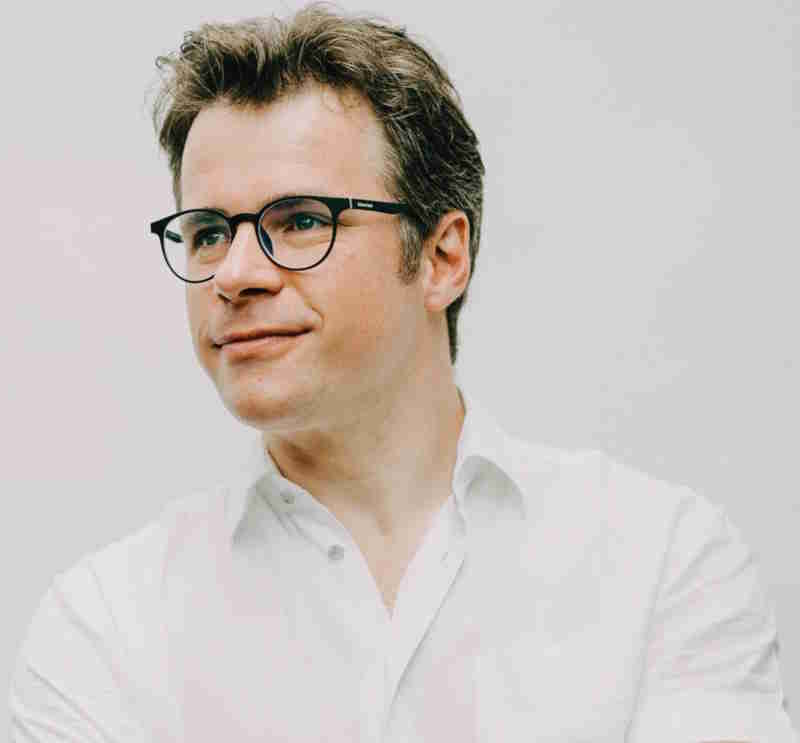
| Jakub Hrůša | |||||
| Royal Opera Chorus Orchestra of the Royal Opera House London | ||||||
Date/Location
Recording Type
|

| Amfortas | Christian Gerhaher |
| Titurel | James Platt |
| Gurnemanz | Brindley Sherratt |
| Parsifal | Stanislas de Barbeyrac |
| Klingsor | Mark Stone |
| Kundry | Ekaterina Gubanova |
| Gralsritter | Ryan Vaughan Davies |
| Jack Sandison |

Musically sublime dystopia: Titov and Hrůša’s new Parsifal at the Royal Opera
The music of Parsifal is up there with the all-time greats, but its story and ideas are abhorrent – even the Royal Opera programme describes them as “questionable” and “problematic”. How to present such a piece? The answer in Evgeny Titov’s new production would appear to be “less is more”: don’t mess with the story, don’t add your own opinions, just give the audience enough visual material to keep them interested, make them believe in the emotions of the characters and leave the rest to the music and its magic.
Given the performance of Jakub Hrůša and the Royal Opera Orchestra last night, it was a winning strategy. The orchestral textures covered us in wave after wave of comfort-giving sound, constantly ebbing, flowing, shifting, each wave new and familiar at the same time. String ensemble was perfection, horns and brass refulgent while still precise. You can’t get the full blended sound effect of the sunken Bayreuth pit at Covent Garden, but after some early nervousness, the orchestra came close. Hrůša exerted millimetre dynamic control, both on the shape of individual phrases and on the longer arcs. Time and again, any concern of “do I really like what all this means” was simply washed away by wonderment at Wagner’s music.
We were in low voice heaven. Despite not being the title role, Gurnemanz owns this opera and Brindley Sherratt gave us a Gurnemanz for the history books – authoritative, melodious or hard-hitting as needed, a complete mastery of the role. Every German word was delightfully clear – which was the case for virtually all of the singers, a rare achievement these days. We know that Christian Gerhaher has glorious timbre, intonation and clarity, but his Amfortas also showed a depth of anguish far greater than anything I’ve heard from him. James Platt was a massive voice as Titurel, not quite credible as an enfeebled monarch, but thrilling to listen to none the less.The title role can be sung by heldentenors with a dark baritonal edge, but not here. Stanislas de Barbeyrac was youthful, bright-eyed and bright-voiced, never lacking in power, always contrasting with the pain that surrounds him.
In Act 2, Ekaterina Gubanova and Mark Stone showed exception vocal acting, their mental duel riveting. Gubanova’s interpretation of Kundry was often painful to watch, her nature as free spirit very much taking second place to the fact that this woman is abused by everyone, from the knights to Klingsor to a vengeful deity. Stone’s Klingsor was a classic braggart and bully, strutting and revelling in his own power.
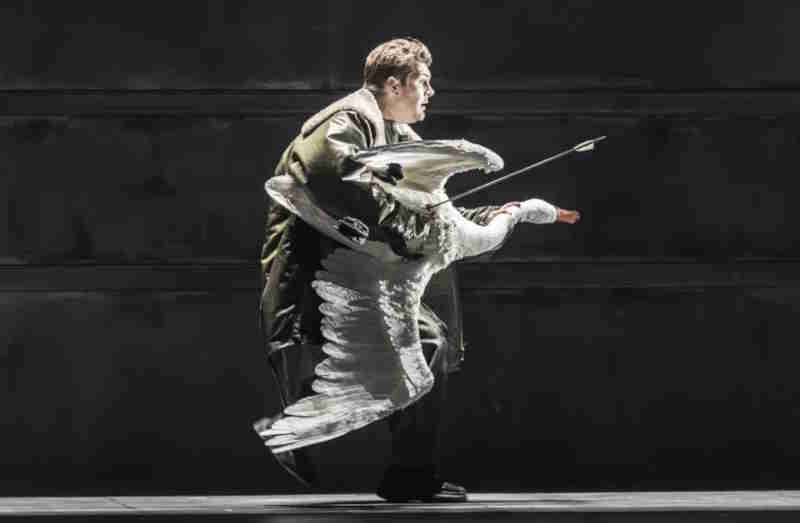
Titov, set designer Étienne Pluss and costume designer Esther Bialas place the opera in a time and place which is modernish but unspecific. Their Monsalvat is a truly miserable place – grey, blocky, militaristic, the watchmen seeing the landscape through CCTV screens – by Act 3, it has become truly decrepit. No weapons are carried which might give a more precise era, except the three in the libretto – the Spear, Parsifal’s bow (its arrow gruesomely in a lifelike swan, still in its death throes) and Sir Ferris’ sword that Parsifal carries. We never see the Grail. Amfortas is a Christ-like figure and the knights fill their cups with blood from his wound.
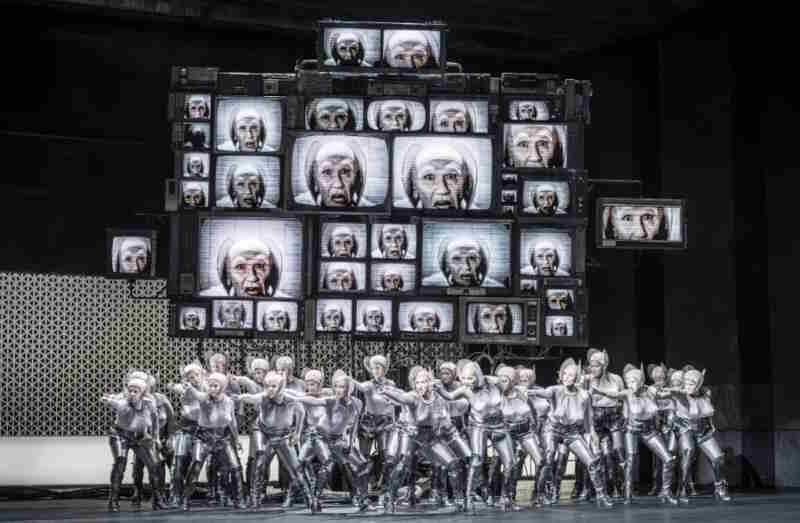
Klingsor’s garden is a disturbing illusion on a steampunk-style video wall. Initially, it displays animated versions of Renaissance religious paintings; this shifts to multiple clips of Otto Pichler in the guise of “Mama Flower”, a ghastly version of the Flower Maidens. These start (particularly unsettlingly) as a set of child ballerinas, but then become adult in costumes that are a sexualised hybrid of Star Trek and The Handmaid’s Tale – there is then something of both Busby Berkeley and Bottom in A Midsummer Night’s Dream when they remove most of Parsfal’s clothing and place one of their large-eared headdresses on him.
So far, so dystopic, but it’s in the Personenregie that Titov really shines. One of many outstanding moments is in Act 3 when Parsifal arrives and Gurnemanz demands repeatedly that he uncover his face and drop his weapon, the buildup of tension becomes almost unbearable.
Is there real redemption here? Does redemption even have any value when faced with a God who submits Amfortas to unsurmountable temptation and then mercilessly torments both him and Kundry without regard to the repentance of either? My instinct says no, the music says yes. Titov lets you decide for yourself, except for one change. In the end, when Amfortas is to be released from his suffering, there is only one way out, and Titov takes it.
This production is suffused with signs of Barrie Kosky’s influence, Pichler being better known as the choreographer of many Kosky productions. But Titov is also showing a new, independent voice and the musical performance is outstanding. If you love Parsifal, this is a must-see. If you don’t, this might just be the one to convert you.
David Karlin | 02 October 2026
Bunkers, CCTV and fembots in elusive vision of Wagner’s mystical masterpiece
Grail, wound, spear: some of the narrative trappings of Wagner’s final opera are immediately recognisable as symbolic. Others – woman, saviour, chastity, seduction, suffering, death – are harder to pin down, lodged in the half-light between the literal and the metaphorical. Wagner’s score is his most beguilingly luminous; its critics have pored over the work’s commitment to racial purity, its misogyny, its religiosity. The question that Evgeny Titov’s debut production for the Royal Opera poses is whether we really believe in the story Parsifal tells – the fall, the curse, the redemption through purity – and what it means if we want to.
The pure fool? … Stanislas de Barbeyrac as Parsifal at the Royal Opera House. Photograph: Marc Brenner
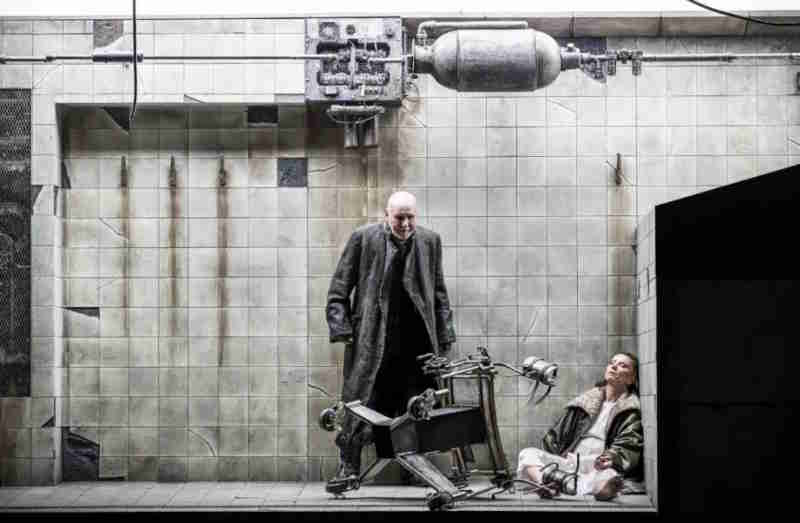
Titov’s staging explains as little as possible. In Etienne Pluss’s sets, the grail realm is an underground bunker hewn from monumental stone blocks that trundle slowly around the stage. There are CCTV screens and a grimy washroom where Amfortas – the fallen King – is scrubbed down by Grail Knights in breathing apparatus. Costume designer Esther Bialas has the Knights in anoraks. Kundry (the virgin-whore dichotomy incarnate) wears black leathers at first, virginal white later. In a rare moment of literal-mindedness, Titov has Parsifal arrive holding the swan he has shot, which twitches gawkily until the orchestra heralds its demise.
Evil Klingsor’s kingdom is another bunker – no enchanted garden here, just a loud suit, a telephone for barking orders, more screens with wiring that curls serpentlike across the floor and cabinets displaying his treasures: an Egyptian mummy, a crown, the sacred spear. (In another of the production’s less convincing details, Parsifal breaks the “glass” to retrieve the spear with an unsatisfying plastic crunch.) We first encounter the flower maidens as a disturbing gaggle of little girls chasing around Klingsor’s lair. Their grown-up counterparts are fembots in headdresses and silver hot pants, part chorus line, part Handmaid’s Tale. The effect is grotesque – but how could it be otherwise in 2026?
Some of the stage pictures and much of the subtle lighting designs riff on the language of religious painting. Other details raise questions rather than answering them: the leather restraining straps used on Amfortas during the grail ritual, the metal gynaecological chair in which Kundry cowers. Moments of physical tenderness stand out, shocking amid so much implied and – in Titov’s remarkable closing coup de théâtre – explicit violence.
Flower maidens recast as fembots … Evgeny Titov’s production of Parsifal for the Royal Opera. Photograph: Marc Brenner
This production’s power also depends on the musical performance, which threaded beauty and emotional intensity through so much equivocation. Conductor Jakub Hrůša charted long lines through Wagner’s enormous score, taking time between some musical paragraphs and pushing precipitously onwards elsewhere. The orchestra was on superb form – woodwind featherweight or saccharine or keening painfully, the strings producing sound alternately in reams of satin and razor-sharp shards, the brass foundry-fresh – at times blending into a single, majestically organ-like tintinnabulation.
Brindley Sherratt was a moody, complicated Gurnemanz – some nasty high notes standing out against his granite lower register – but his storytelling was as compelling as ever. Ekaterina Gubanova was a constantly shapeshifting Kundry, her tone reactive, from shrieks to quasi-speech, via finely sculpted phrases that seemed to skim the orchestra’s surface. Mark Stone’s Klingsor managed to be both oleaginous and fierce, James Platt’s Titurel appropriately stentorian. Stanislas de Barbeyrac wielded his gleaming steel of a voice on the title role, his earlier fragmentary mode blossoming into potent, supple declamation in the final scene. But it is Christian Gerhaher’s appalling, wild-eyed Amfortas that makes this production a must-see. In this bleak portrayal of self-obsession, every note he sang oozed misery, every phrase felt unmissable.
Flora Willson | 2 Oct 2026
Hrůša excels in the new RBO Parsifal
Director Evgeny Titov makes his Covent Garden debut with this new Parsifal, a vision made visceral via Etienne Pluss’ sets and D. M. Wood’s lighting. ‘Dystopian’ seems the mot juste for Titov’s take on Wagner’s Bühnenweihfestspiel. Acts One and Three take place in what the programme describes as ‘evoking a monumental space between a bunker, a factory and a cathedral,’ with the progress of years showing markedly in the final act’s crumbling architecture: a delineated interiority one step further than the Wagner-period house of Jetske Mijnssen’s staging at Glyndebourne. Titov’s is a Parsifal that sees little light: often literally. The (dead) swan is the only real white in act one; costumes are predominantly black, while Parsifal appears in grey – a liminal colour between dark and light, as befits his status on arrival. There is machinery on stage, but from somewhere perhaps Planet Earth-adjacent: steampunk seems to be an influence in the television screens of Klingsor’s act two lair. But The Handmaid’s Tale, another alt-world, seems close by in the headdresses of the Flowermaidens’ almost insectile costumes (by Esher Bialas). The sense of oppression of the first act and its sense of militaristic observation speaks of a stifling, fear-based society; the World’s surface seems another universe.
The staging is stark, with monumental (mobile) pillars perhaps evoking the undercroft of a temple or cathedral, the first of several nods to Christianity. A central concept seems to be the closing of cycles. Firstly, Kundry’s endless cycle of incarnations, listed by Klingsor as Gundrygya, Herodia, Kundry, implying in the process others: Rebecca Franks, in her booklet essay Sexism, Feminism and Musical Temptation in Parsifal, posits Lilith the primordial demoness as the ‘Urteufelin’ of Wagner’s text. The second ‘closing’ is that of Amfortas’ eternal pain, repeatedly but only temporarily eased via bathing. These cycles are broken – but not, perhaps, how one might expect. At the close, there is no white dove of peace descending from above and circling above Parsifal-Redeemer’s head; instead, the end is bloody, and shocking, the spear put to a use that is either unholy, or merciful, depending on one’s perspective (and possibly linking into contemporary discussions of assisted dying). As for Kundry, in a striking gesture her final departure, carried out aloft, is cruciform in nature.
But Titov’s foundational starkness begets dissonance with text: the Good Friday music, with its opening out of Spring, is heard against a dark and dank interior (itself perhaps a metaphorical ‘forest’ of metaphysical entanglings). Starkness begets directness, and with that, the power to cause revulsion: the communion of the knights finds them drinking the blood of Amfortas straight from Klingsor’s infamous wound. Asceticism is another reflection of this foundation: our introduction to Amfortas is Christian Gerhaher in tatters of ‘clothes,’ limpingly wheeling a gurney that will later hold the dying swan and, later still, Titurel’s besheeted body. Thanks to the miracles of technology, we see the swan twitch in its death throes, a visceral reminder of the delicacy of life – a long way from the Muppet Show-reject bouncing rubber swan of Joachim Herz’s 1986 ENO production.
As to the Monsalvat-Klingsor schism, conflict creates extremes, Titov seems to say: not quite the post-apocalyptic world of Nikolaus Lehnhoff’s 1998 ENO stab at Parsifal, that stage dominated by a huge embedded meteorite, but close. Perhaps only in such scenarios can oppositions of pure good and pure evil co-exist (discuss, after glancing at the newspapers of today …).
Other directorial sleights are worthy of comment. In his realm, Klingsor keeps the artefact of the spear in a glass cabinet that is shattered, and memories of the Regents Opera Bethnal Green Ring seem unavoidable. A troupe of very young girls in colourful frocks implies they are proto-flowermaidens. Parsifal suckling Kundry’s breast in the second act seduction, while it makes sense in the context of Kundry’s emotional manipulation of Parisifal via his mother, seems crass. There are a lot of ideas and, while not quite the directorial overwhelm of William Kentridge’s recent Glyndebourne Monteverdi Orfeo, perhaps some thinning in revivals (should they occur) might be worth considering.
There is clearly deep thought here, though, as there is in aligning the production with the music, most powerfully placing that act Two Kiss between Kundry and Parsifal directly on the arrival of the major triad (remembering that in Klingsor’s realm, even tonality is inverted, bastardised: the major triad appears as dissonance because Wagner has accorded a traditional dissonance, a diminished sonority, normative status via repetition and prolongation).
Whatever the controversies of the production, there were glories galore elsewhere. It is worth starting this time not with the singing but with the pit, and the miracles conjured by the evening’s other sorcerer, Jakub Hrůša. The RBO Orchestra took technical excellence – near-perfection – as the minimum for a performance of infinite range, from the gentlest of string caressings to the most monumental,ritualistic brass to the tenderest of woodwind solos, particularly from the oboe. Tempos were perfectly judged (this was overall a relatively rapid Parsifal) – it moved, but never felt rushed. Hrůša’s clarity of baton is stunning. There was just one moment that raised an eyebrow: He took the Flowermaiden’s scene (‘Komm, komm, holde Knabe) in six, and the result was somewhat lumpy, the reverse of Wagner’s intent, surely; and yet, Kundry’s Herzeleide Narrative (‘Ich sah das Kind’) was in a more fluid two. But, my, how lucky are we to have him: Hrůša shaped the drama superbly, with a real feeling of acts One and Three as two structural pillars containing the more overt drama of act Two.
So, then, to the singing. Stanislas de Barbeyrac has impressed multiply in the past, not least as Florestan Fidelio (Insula, both Paris and London), as Max Freischütz in Aix and London (Insula, again) and, most recently, as Siegmund Walküre at RBO (review). He is a world-class titular hero, nuanced, untiring. He looks the part, too, youthful enough for his Fool-ish innocence to be believable in his first act exchanges with Gurnemanz. Acting goes hand-in-hand with musical excellence here, giving extra charge to his act Two scene with Kundry, here Ekaterina Gubanova (who has previously impressed at Covent Garden as Venus Tannhäuser in 2023, and as Neris Medea at the Met the previous year). Her Kundry was, perhaps, less impressive: while the aggressive nature of her opening ‘Parsifal, weile’ might well have been a conscious decision (given the mirroring force of ‘Gelobte Held’), ‘Bekenntnis, wird Schuld …’ went for absolutely nothing, emotionally.
Brindley Sherratt’s Gurnemanz was a masterclass of storytelling in his long narrations, gripping from first to last, only some strain and thinning of tone in his upper register a small issue. But this is a nuanced assumption that rivals John Tomlinson in this role (surely there is no higher praise).
When Christian Gerhaher presented his Wolfram Tannhäuser here in 2016 (under Hartmut Haenchen), he impressively brought a Lieder-singer’s resonance with text to the part. This, though, was a stage beyond, an interpretation of Amfortas surely to be remembered for decades to come. The staging asks for his vulnerability (he is naked for the bathing) and depictions of extreme pain, and how Gerhaher delivers. His voice is perfect, too, for the role: raw yet somehow infinitely beautiful and capable of myriad shadings of pain.
The besuited Mark Stone was a smarmy, repellant Klingsor, a modern representation of evil as opposed to some primordial archetype, James Platt a fine, sepulchral Titurel. And all credit to the more collective roles: the enthusiastic Squires (here sung by two female and two male voices, Elizabeth Karani, Lily Mo Browne, Georgi Guliashvili and Emyr Lloyd Jones), the troupe of Flowermaidens, who created an appropriately seductive web of sound, perfectly balanced both within themselves and in the individual brief solos, and the enquiring Knights (Ryan Vaughan Davies and Jack Sandison).
A stimulating evening, beyond doubt. Titov’s staging, packed with ideas, certainly gives lots to think about, while the subversive close causes this Parsifal to resonate on somewhat differently from the norm. The evening as a whole, though, augurs well for Hrůša’s tenure.
Colin Clarke | Oct 3, 2026

 (5/10)
 |
A production by Evgeny Titov (2026)
Brindley Sherratt was announced as being indisposed after Act 2.